
“I found Rome a city of bricks and left it a city of marble.”
Augustus, Roman Emperor
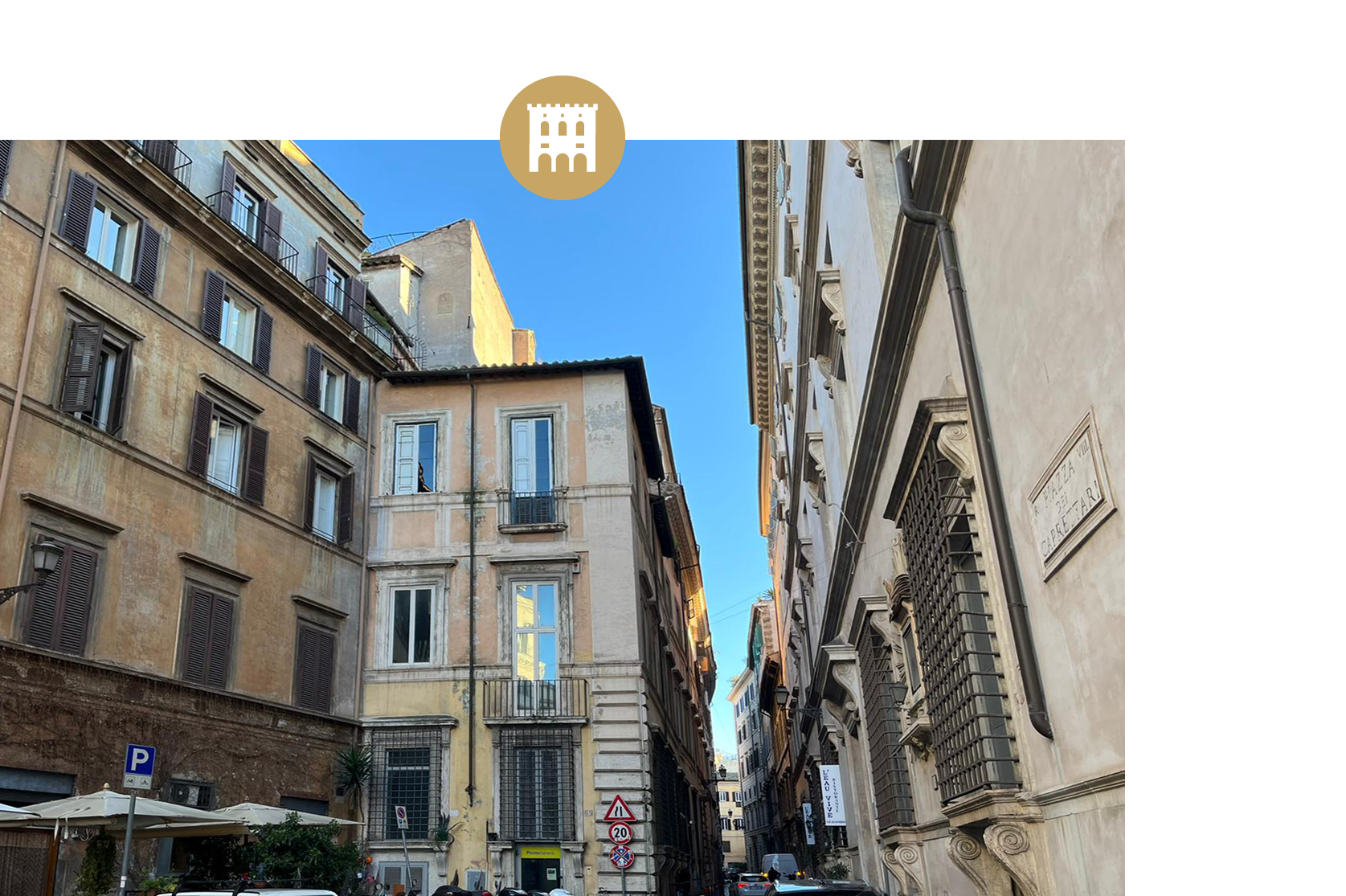
In the heart of the historic centre of Rome, nestled in the maze of streets that mark the urban space between the Pantheon and Piazza Navona, stands Palazzo Nari a Sant’Eustachio. This ancient building takes its name from the powerful Naro family, who commissioned its construction. The name Sant’Eustachio, which is the name of the district where the building stands and which derives from the ancient Basilica of the same name, not only alludes to the geographical location of the building, but also refers to the branch of the Naro family that had already settled in the district in the Middle Ages and distinguished itself from other Roman branches of the same family.
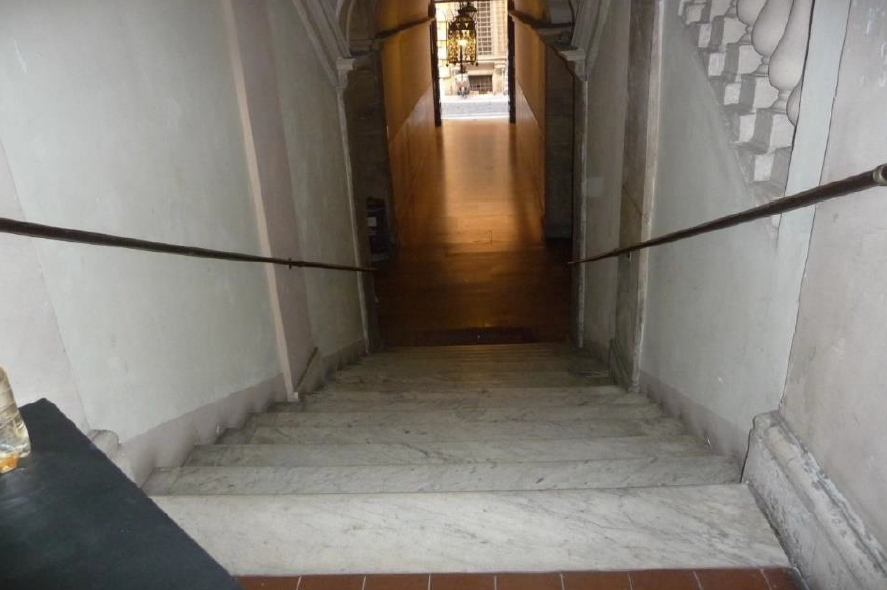
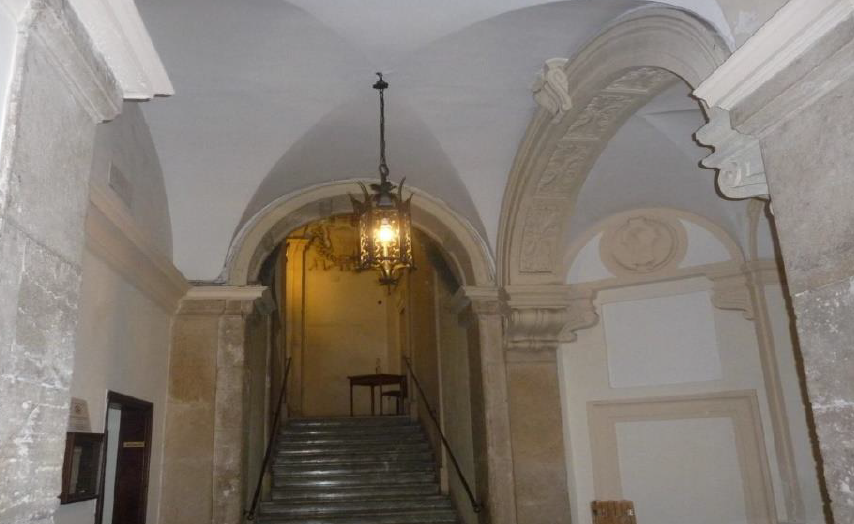
The palace was built at the behest of Bernardino Naro in the first half of the 17th century, based on a design by Bartolomeo Breccioli, who had been commissioned to demolish the old medieval houses that stood on the large block, formerly owned by the family, between what is now Piazza de’ Caprettari, Via Santa Chiara, Via de’ Nari and Via Monterone. The architraved doorway, the cornice and the sides of the windows are decorated with two crescents, the heraldic coat of arms of the Naro family, who wanted to make their ownership of the building immediately evident, so that it could be immediately identified from the outside as the public seat of the family’s affairs, which counted among its most illustrious members military commanders, high members of the papal court and cardinals. As can be seen from these few notes, Palazzo Nari in Sant’Eustachio has intertwined its history with the millennial history of Rome, thus becoming, over the centuries, a precious and tangible testimony to the past of the Eternal City.
MORE I LESS

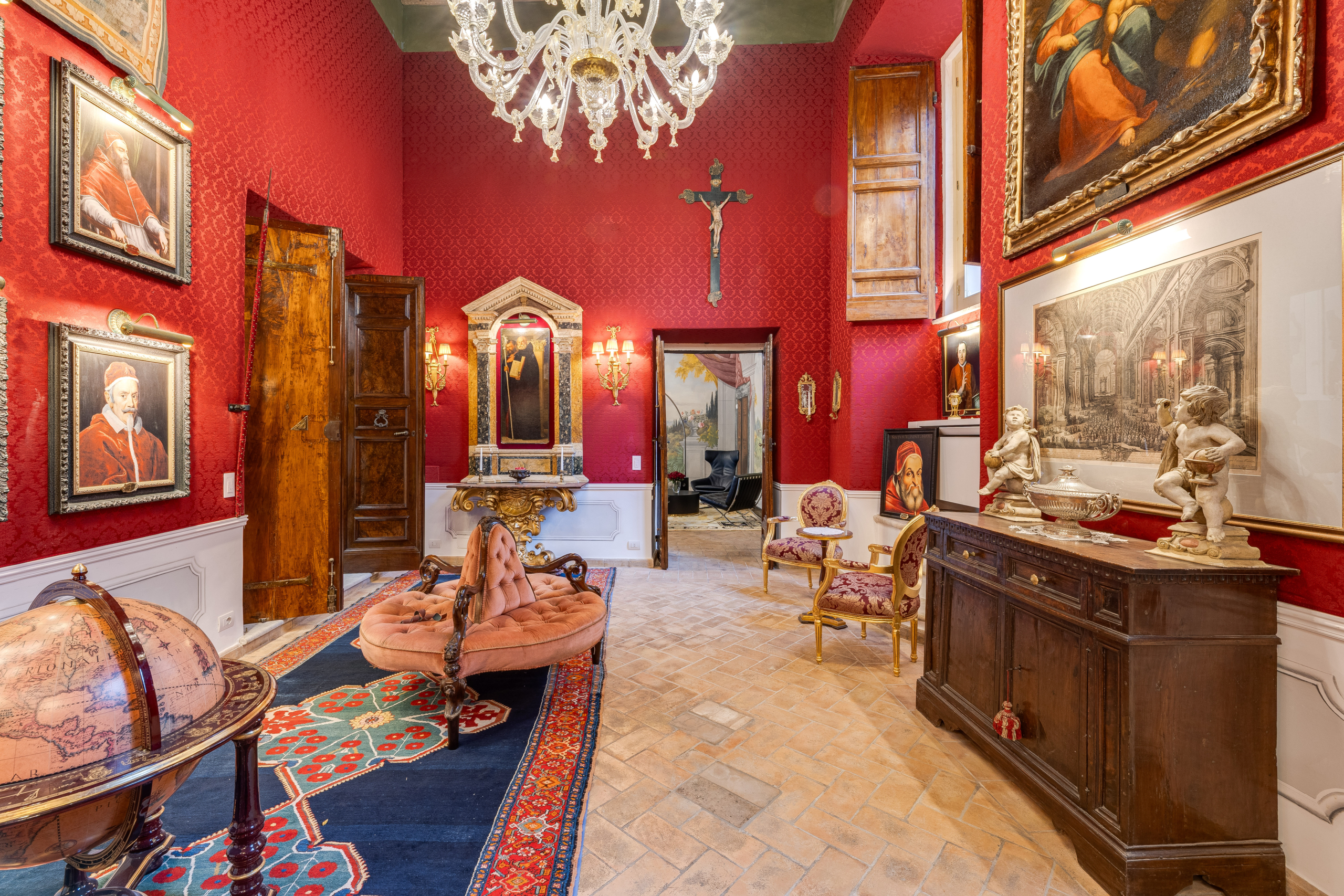
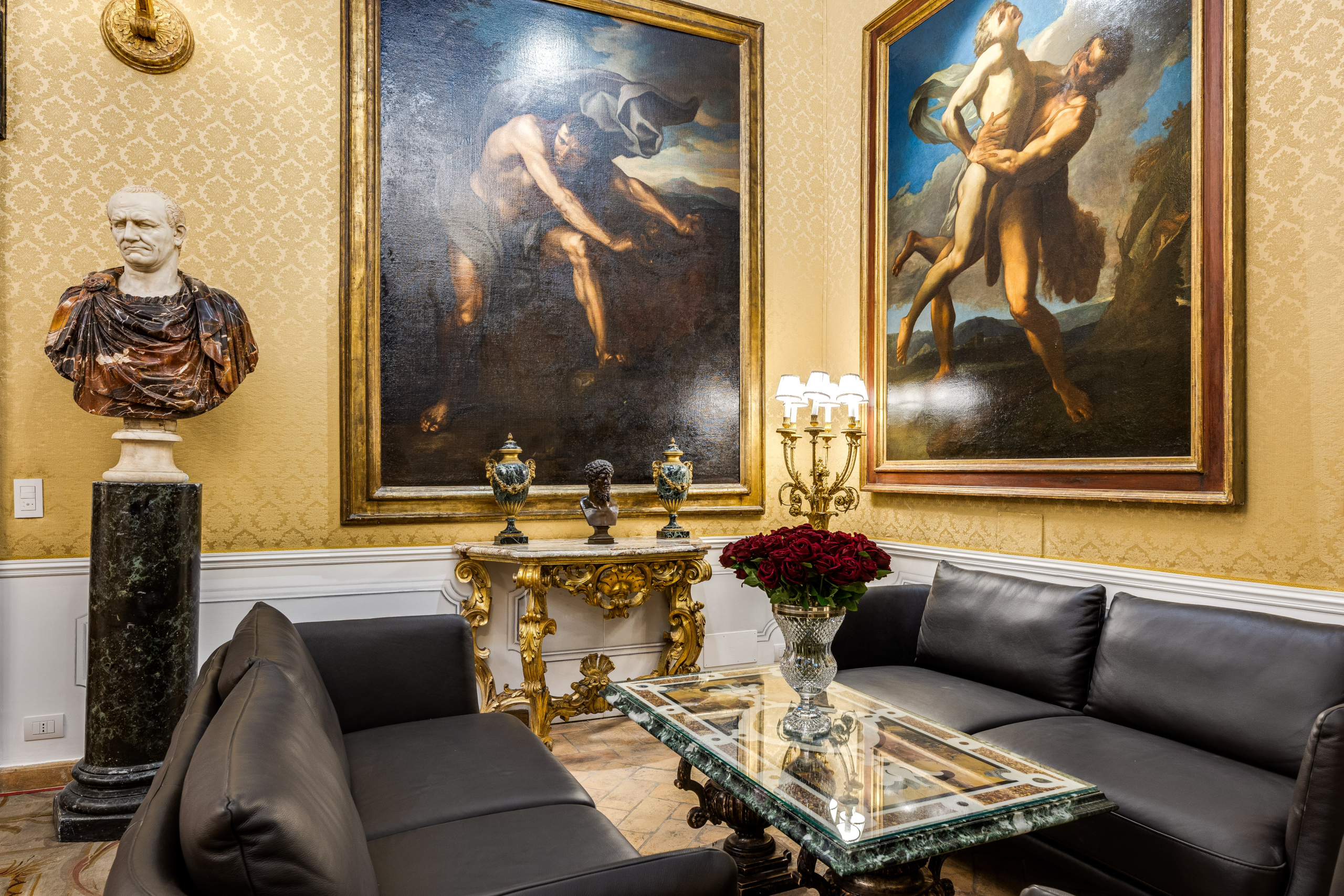
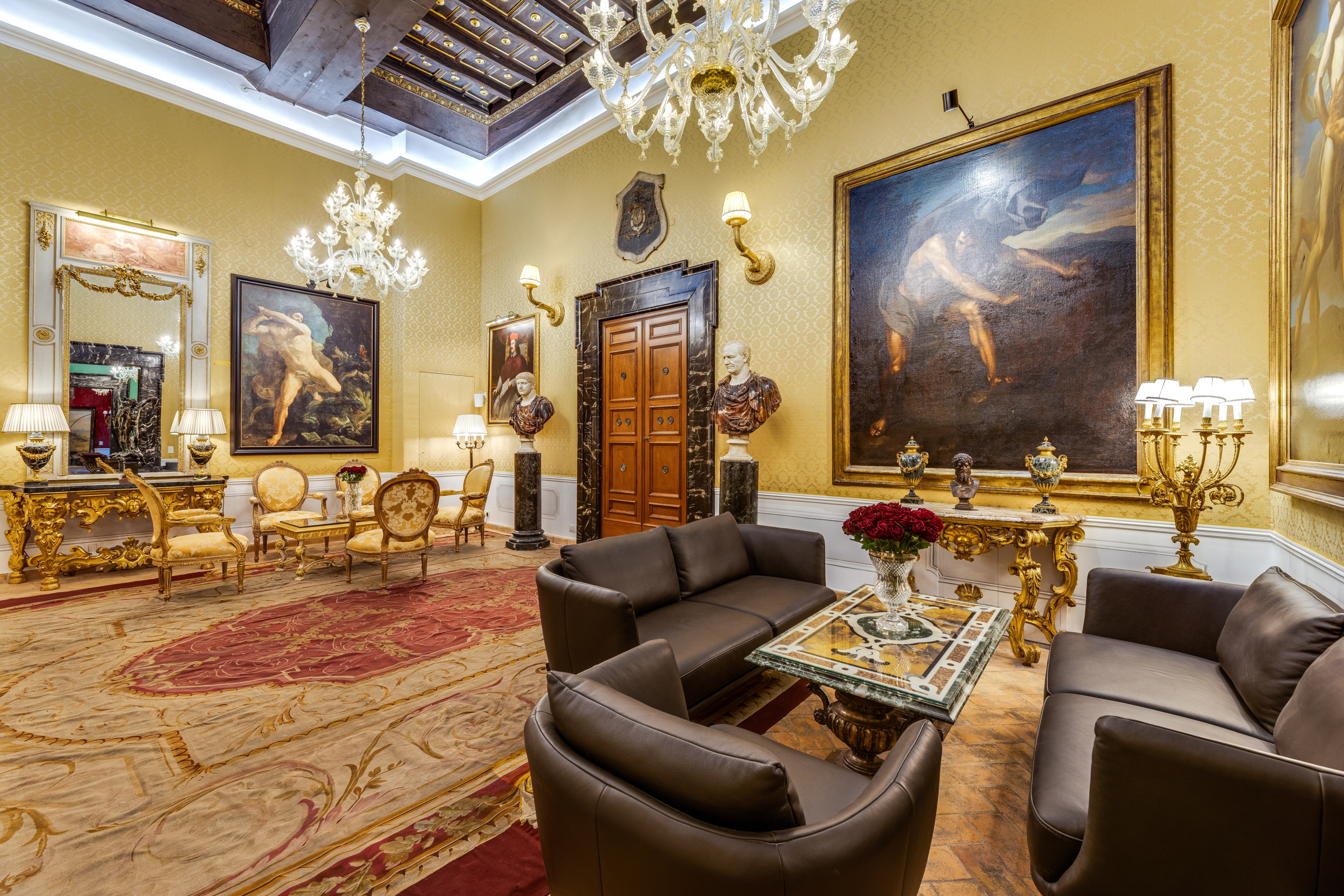
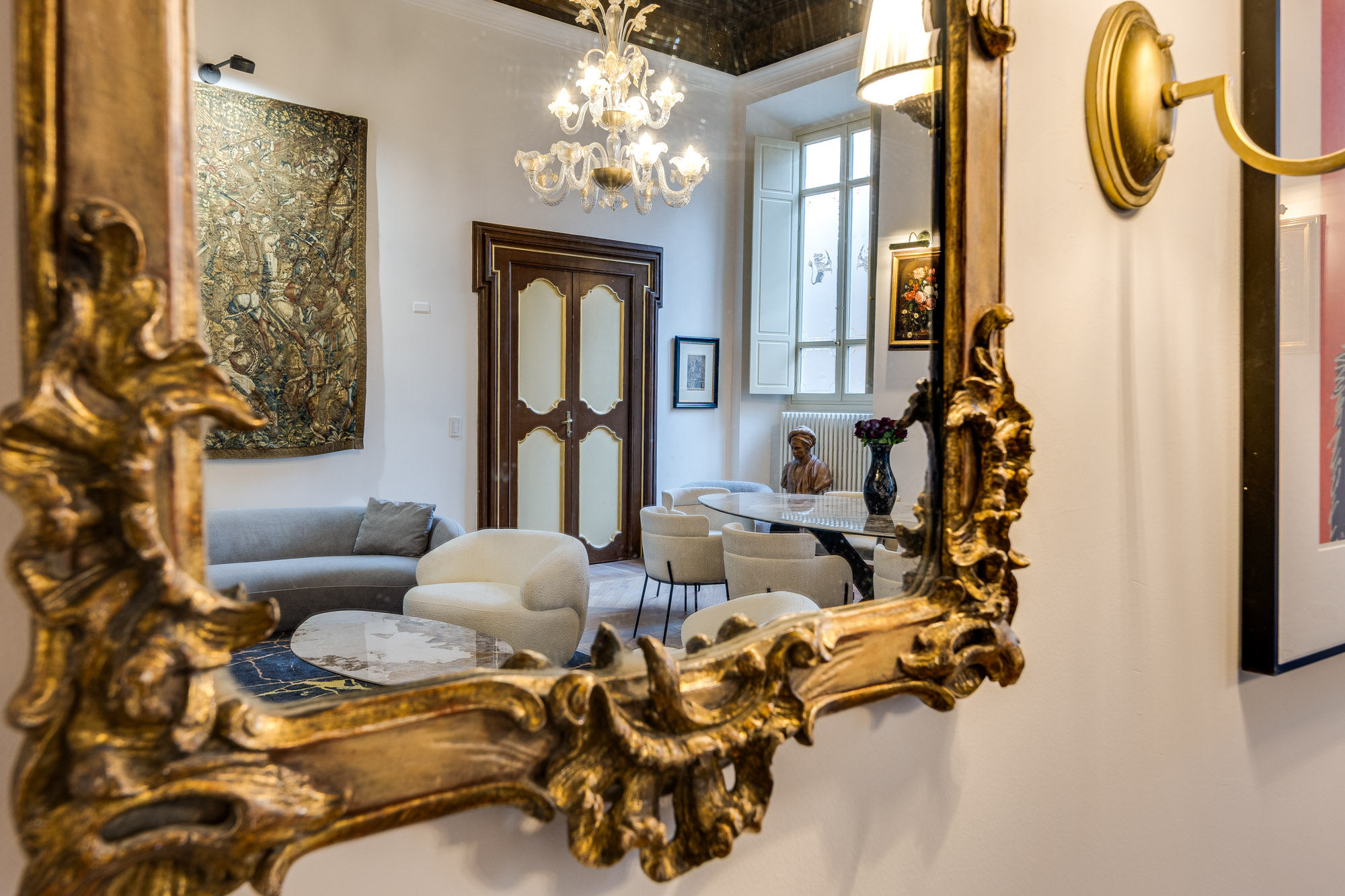
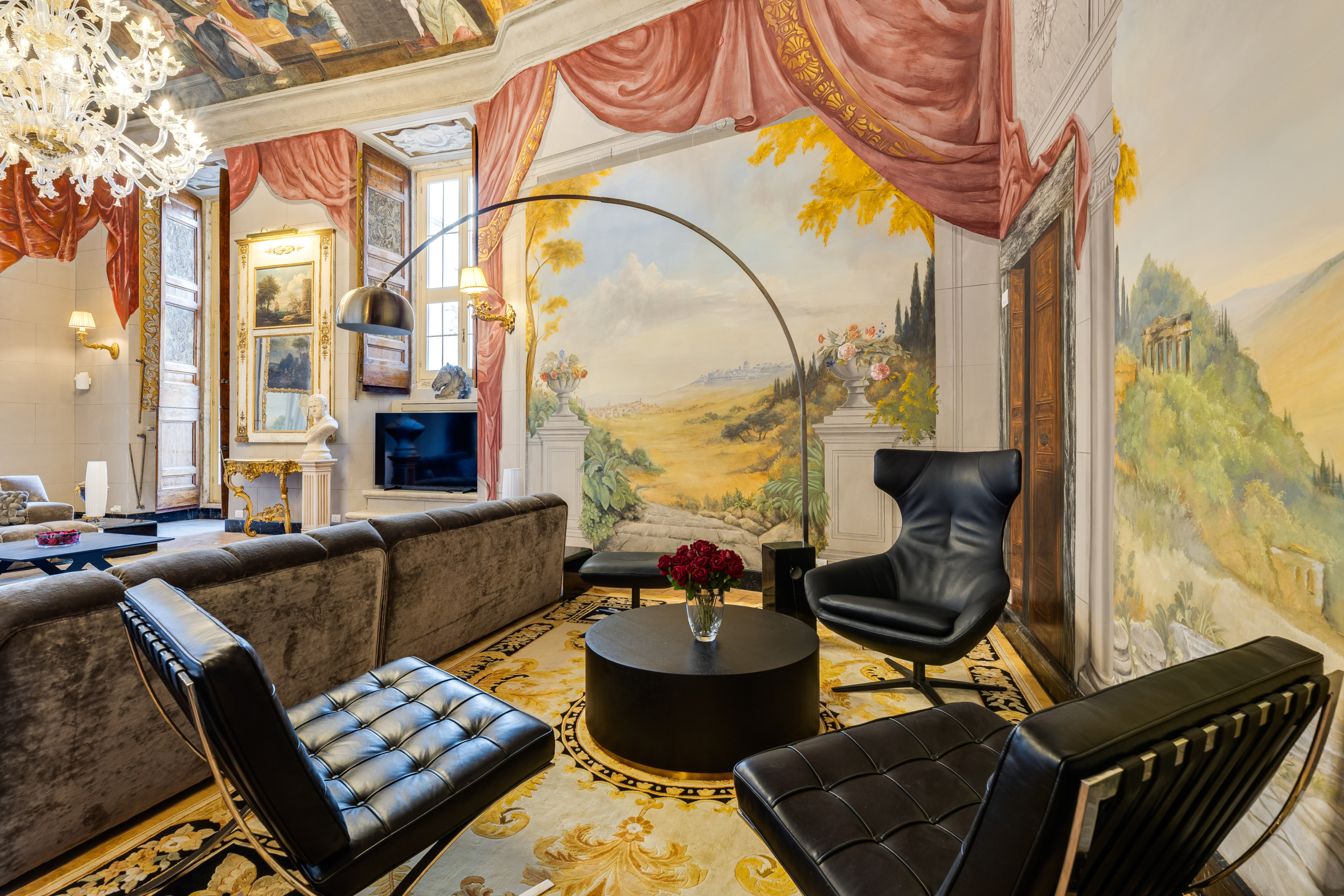
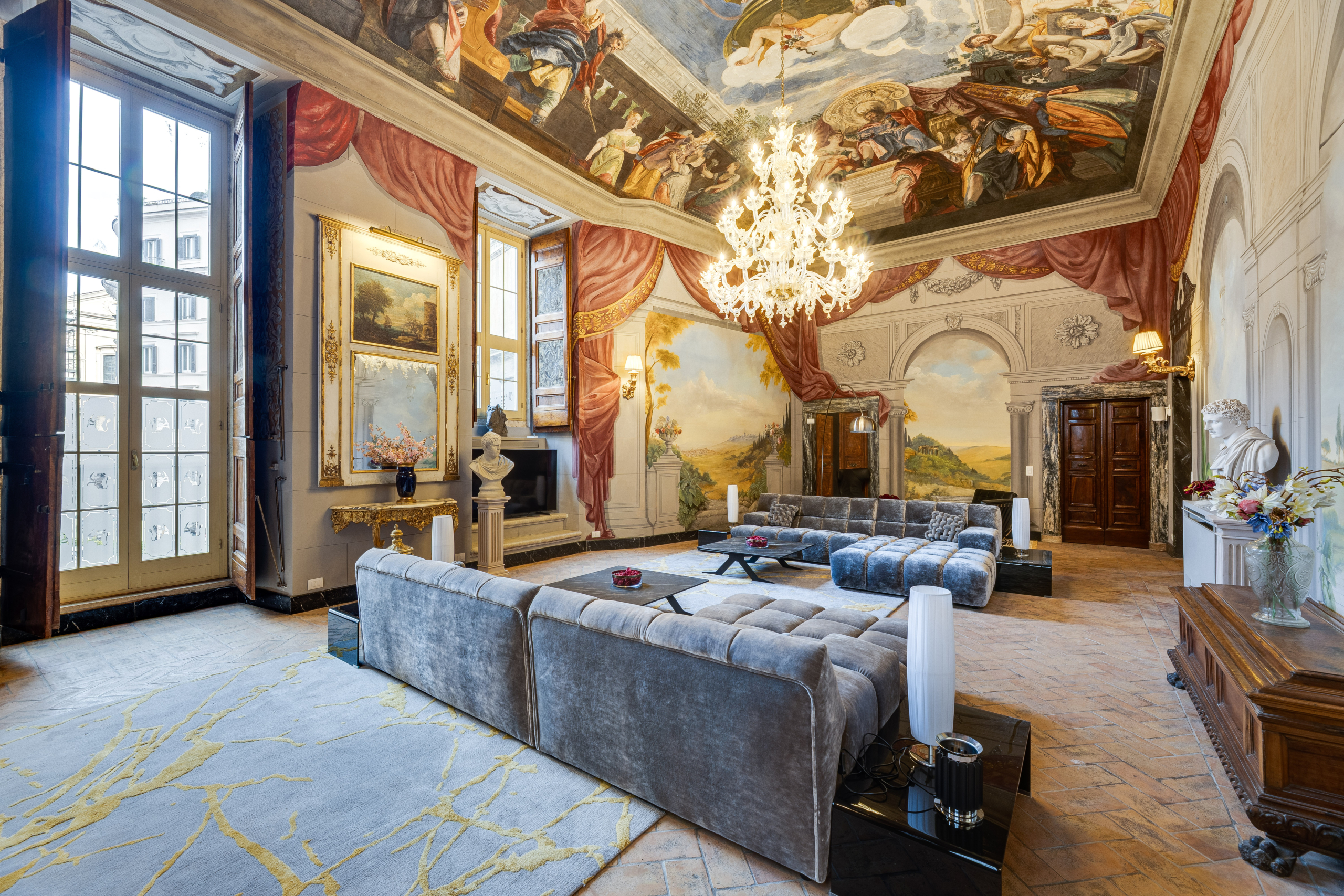
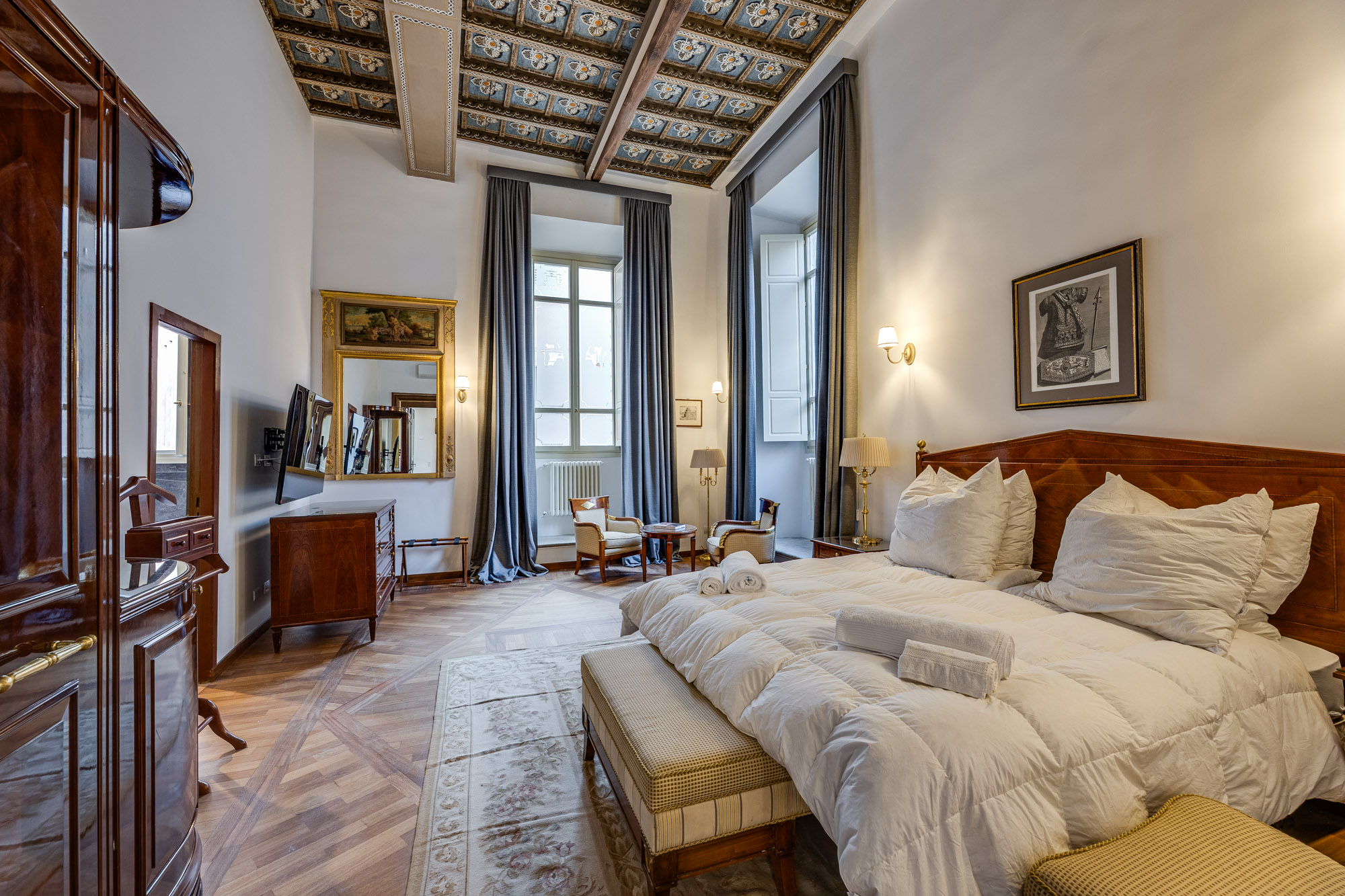
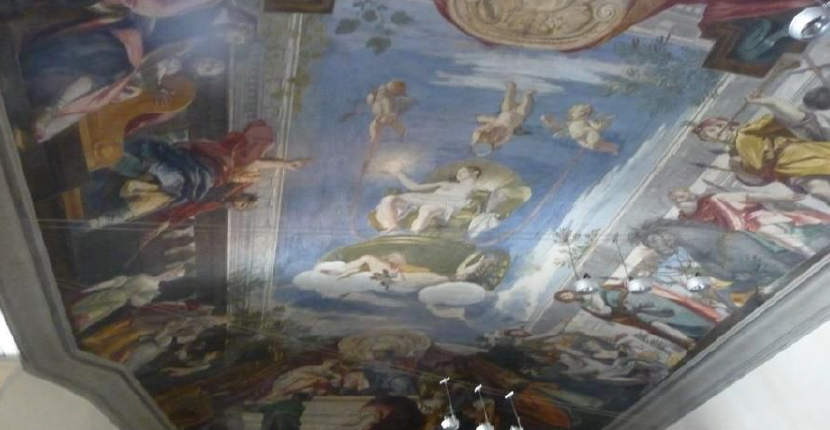
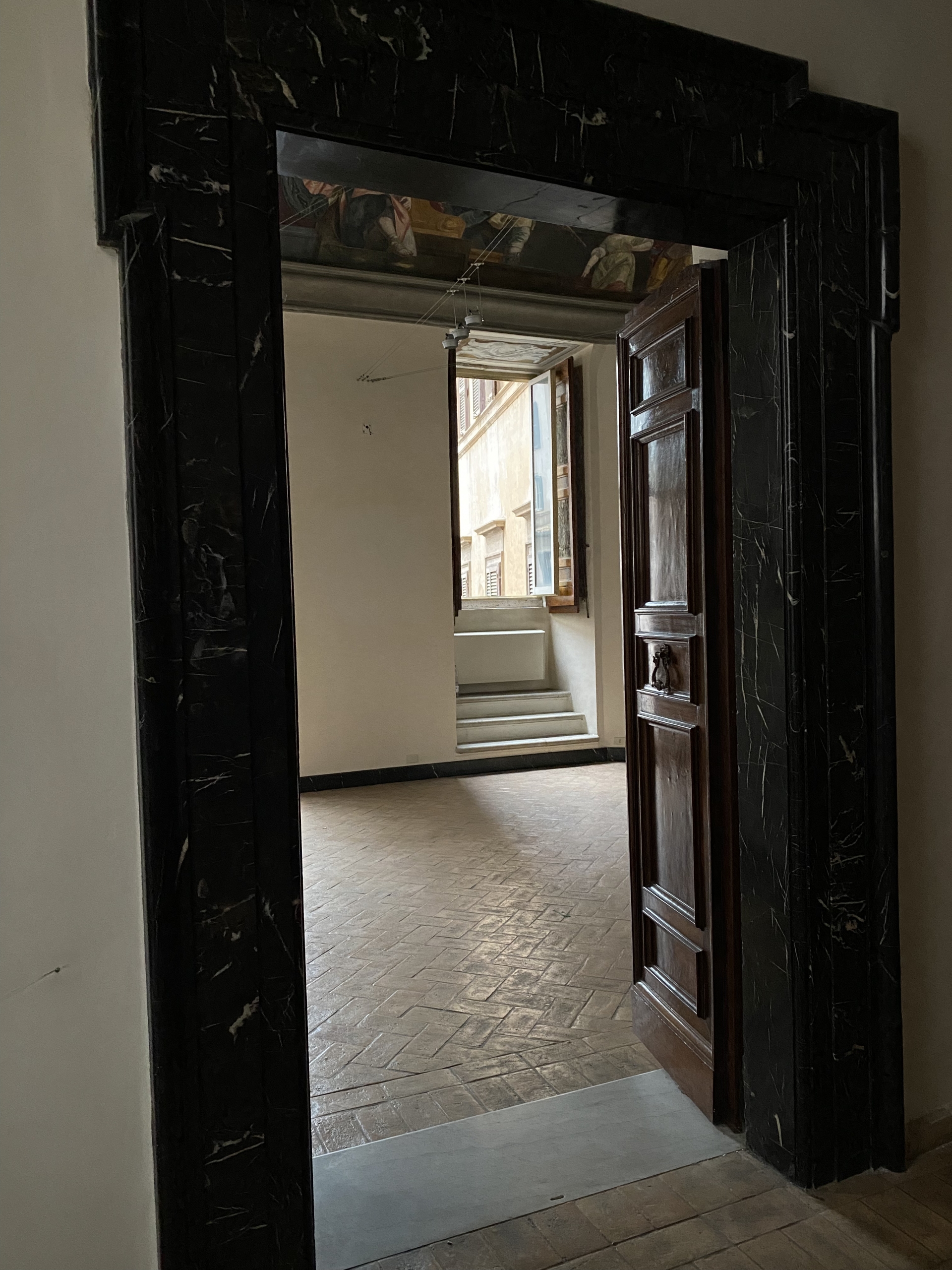
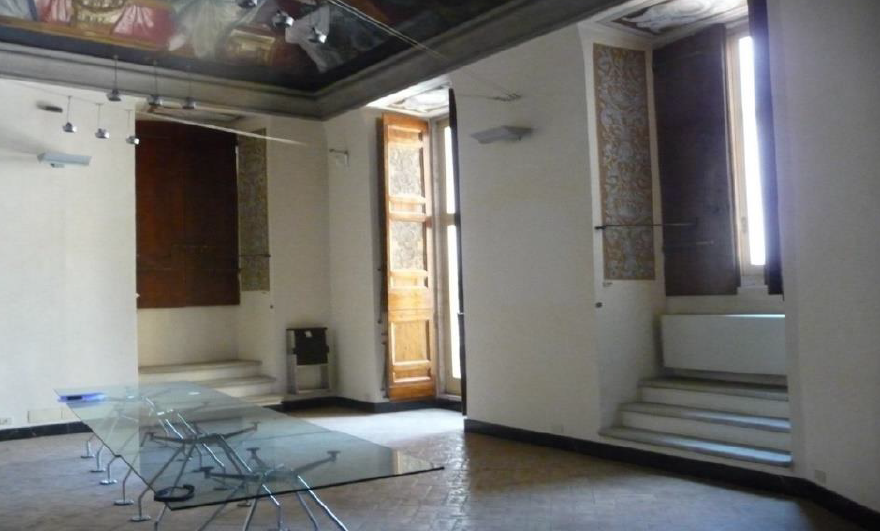
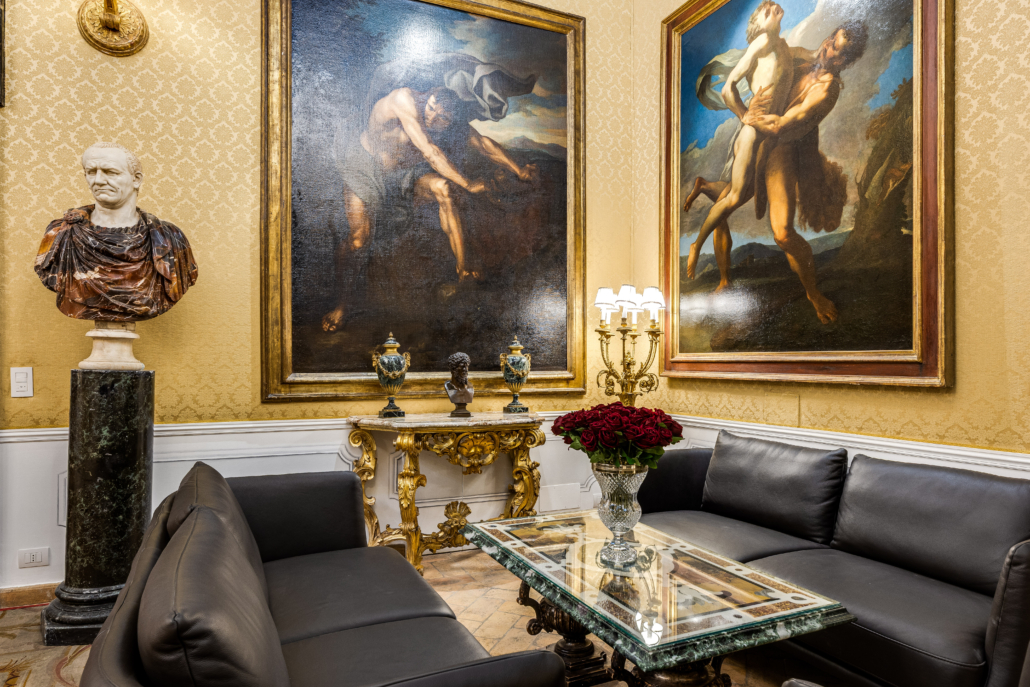
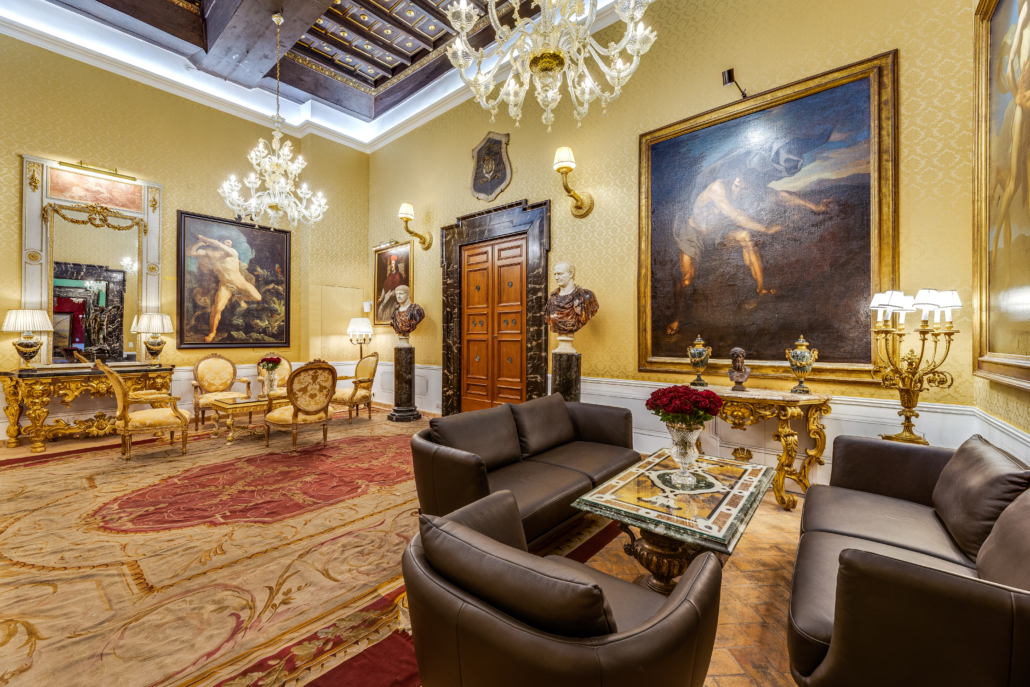
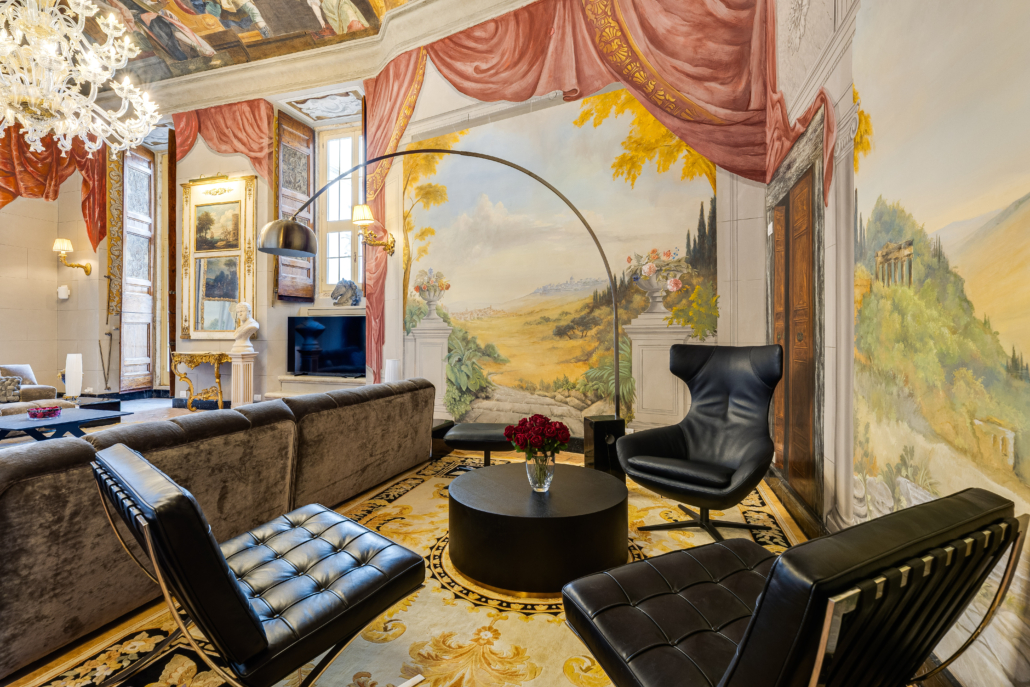
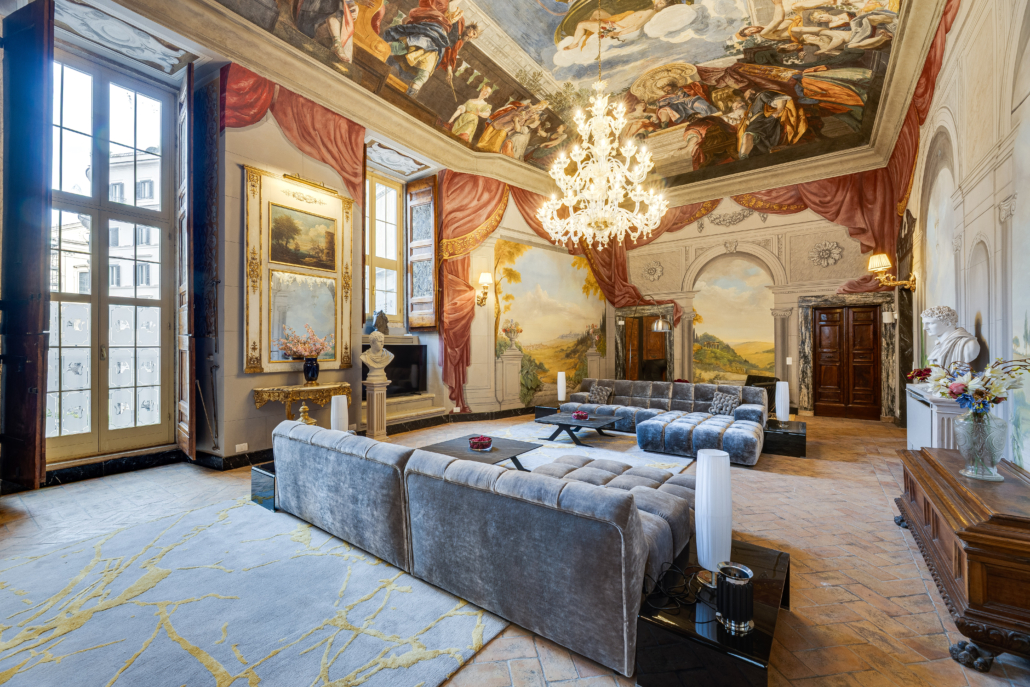
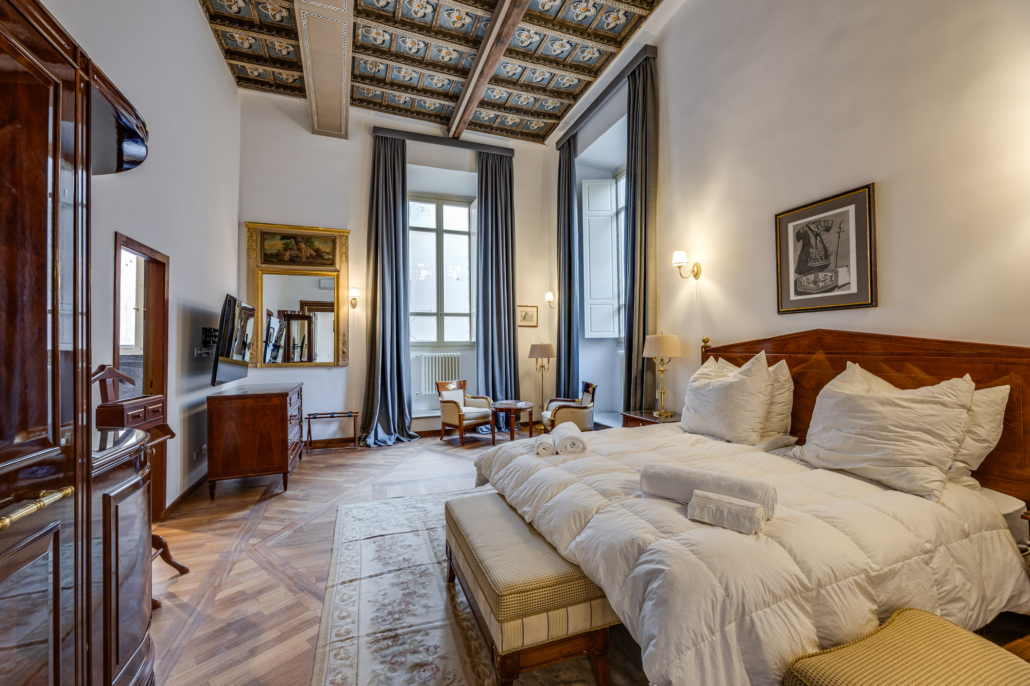
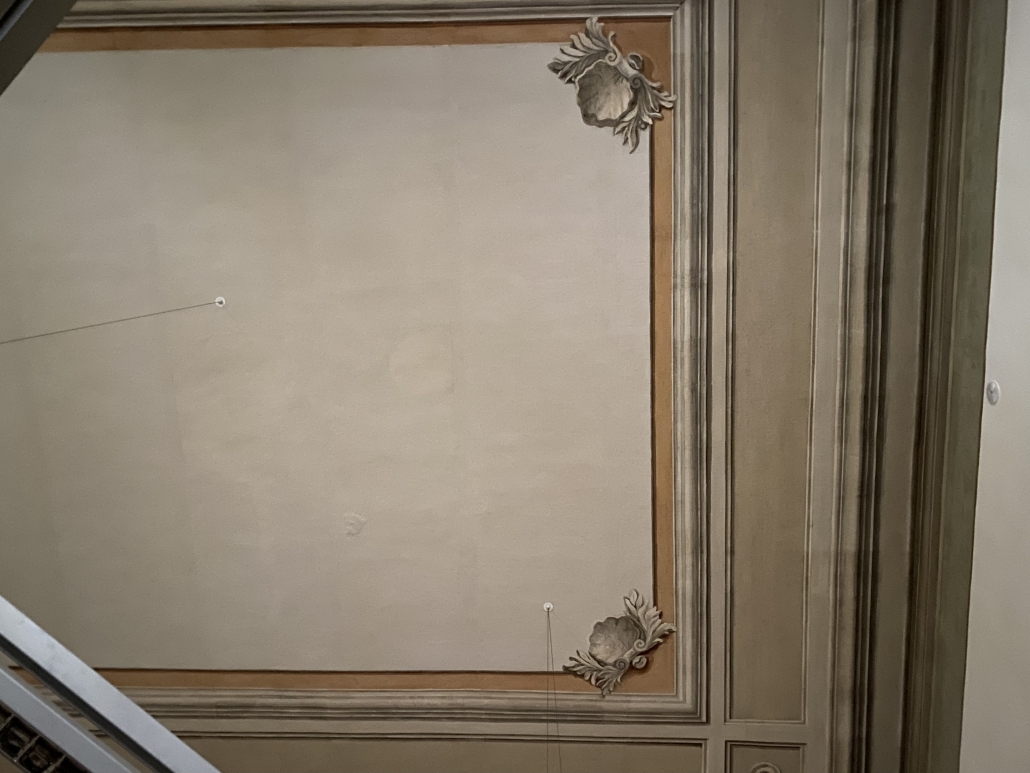
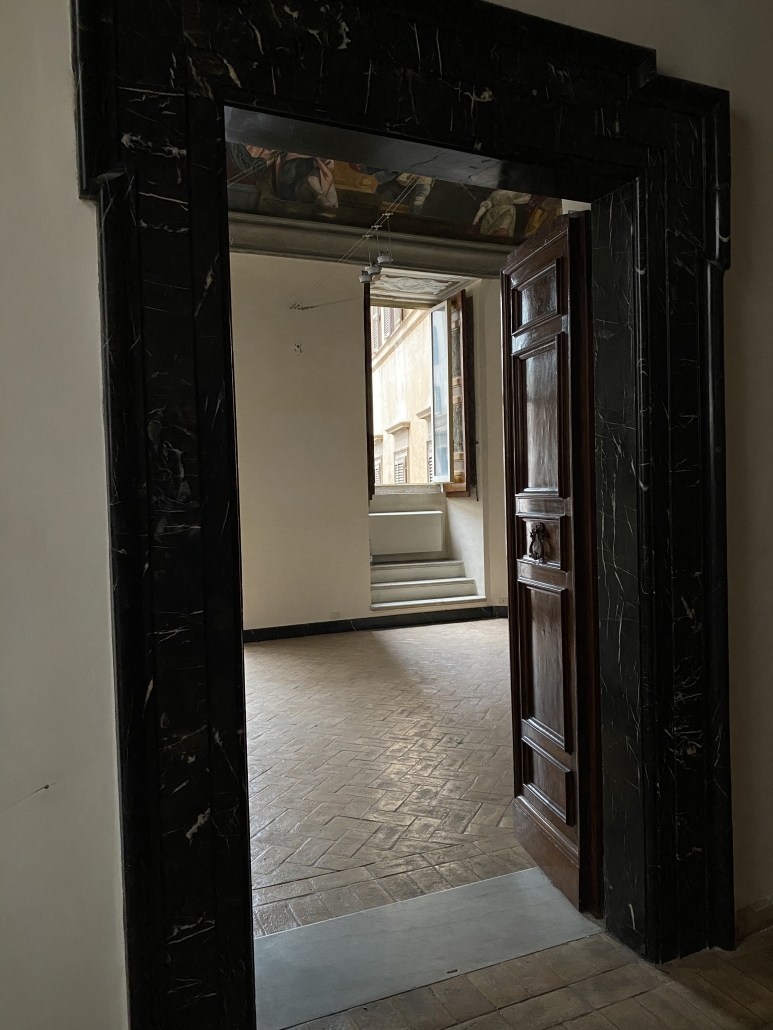
The European Heritage Project has recently acquired an important portion of the piano nobile of Palazzo Nari in Sant’Eustachio, a clear example of early 17th century Roman architecture. The building, although far removed in form and decoration from the peaks reached by the great masters of Roman Baroque, stands out for the ability of its design and plan to fit into the complex urban context of the historic centre of Rome, respecting the spaces that medieval developments had delineated, often in a confused and heterogeneous manner. Palazzo Nari therefore originally also fulfilled an ordering function, occupying an entire block in a central part of the city, where the maze of streets and roads still has a labyrinthine appearance. Not only is the palace remarkable for its particularly harmonious impact on the outside, but its interior is also of great interest. The entire main floor is characterised by large and very high rooms. In five rooms, the ceiling is made of valuable decorated coffers, while on the vault of the main hall, the real gem of the residence, you can admire a large fresco, still splendid after more than three centuries, by Antonio Gherardi. Gherardi, an appreciated painter from Arezzo who worked in Rome at the end of the 17th century, painted a large allegorical scene here for Marquis Fabrizio Nari, the triumph of Reason over Deception, surrounded by four biblical episodes from the Book of Esther.Palazzo Nari in Sant’Eustachio has what might be described as a double structure: on the one hand, the rooms that wind around a central courtyard, more intimate and not visible from the street; on the other, the rooms whose windows open directly onto the public street. This is the typical layout of the urban palace, which, while providing a reserved space, is always projected outwards, towards the city in which it is inserted. After centuries of being the centre of life for the noble Nari di Sant’Eustachio family, the ancestral home followed the family’s declining fortunes: at the beginning of the nineteenth century, the part facing Piazza Santa Chiara was sold and demolished to build a neoclassical palace, while the rest of the building was sold to the Serventi family in 1876. With the acquisition of an important portion of the piano nobile of Palazzo Nari in Sant’Eustachio, the European Heritage Project intends to restore the building to its former glory, re-evaluating its role and importance in the urban context in which it is located.

RESTAURATION AND CONSERVATION MEASURES
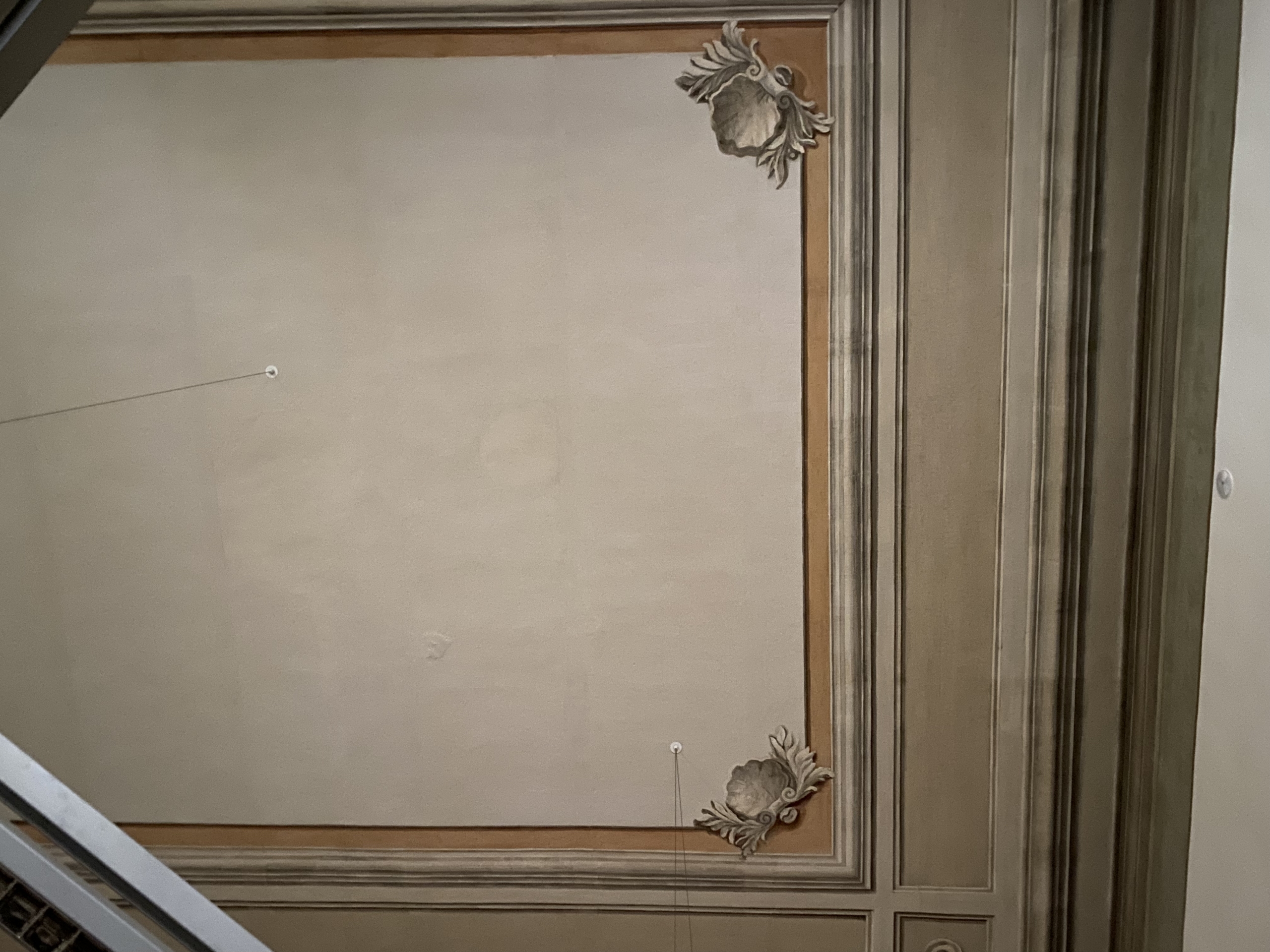
Die Arbeiten begannen 2022 im Piano Nobile. Neben der Grundsanierung aller Flächen standen vor allem die Erhaltung und Restaurierung der historischen Fresken und teils gotischen Kassettendecken im Vordergrund. Fehlstellen wurden von kunsthandwerklichen Restaurateuren ergänzt und die bestehenden Flächen saniert und geschützt. In Zusammenarbeit mit den Denkmalschutzbehörden konnte der Palazzo weitgehend wieder zu seinem alten Glanz zurückgeführt werden. 2023 wurden die Arbeiten im Piano Nobile abgeschlossen. Für 2025 sind der Abschluss der Arbeiten im zweiten Stock und im Eingangsbereich geplant.
THINGS TO KNOW AND CURIOSITIES
The Palazzo Neri is located on the small Piazza Sant’Eustachio. Here, a small coffee roastery of the same name, with an attached café, is situated. This roastery has achieved worldwide fame, so much so that long queues form on the piazza from early morning onwards, all eager to buy its renowned coffee.
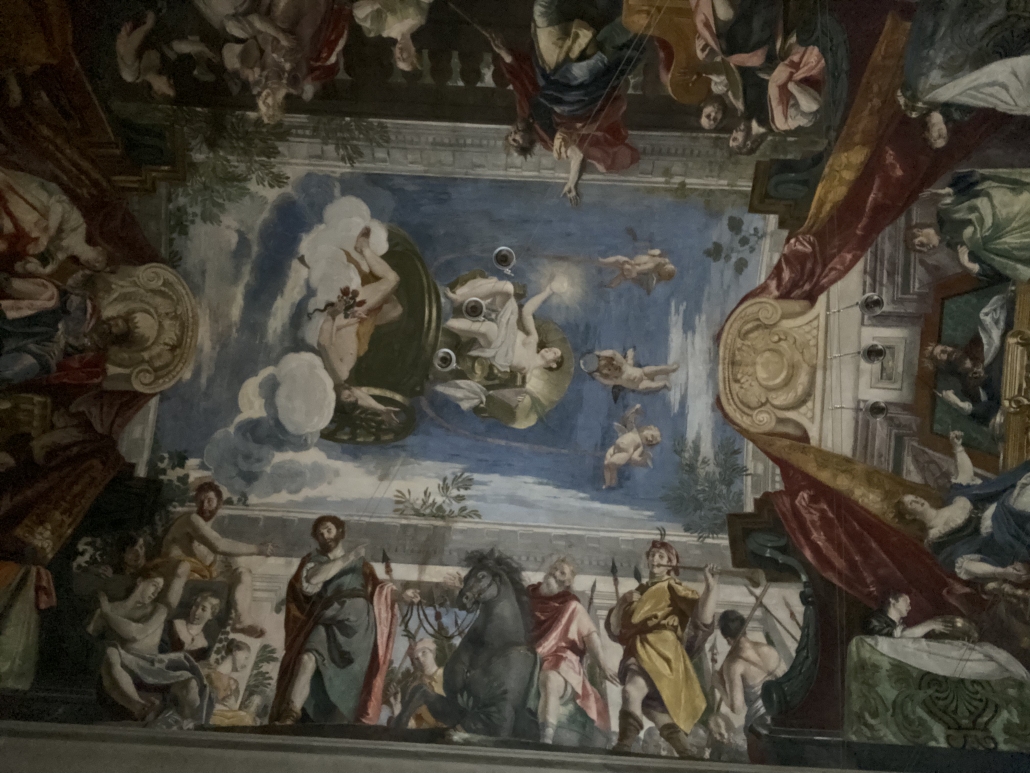
The ceiling frescoes by Antonio Gherardi in the Palazzo Nari a Sant’Eustachio depict scenes from the biblical Book of Esther.
The painter Antonio Gherardi (1638–1702), originally from Rieti and trained in the Roman workshop of Pietro da Cortona, was commissioned in 1673 by the then owner of the Palazzo Nari, Marquis Fabrizio Nari, to paint the ceiling of the piano nobile. After a journey through northern and central Italy in 1667–1669, during which he studied important works of art to round out his training, Gherardi had just returned to Rome to establish himself as an independent painter.
His studies abroad were immediately evident in his first major works in Rome: His ceiling fresco, executed in 1669–1670, in the church of Santa Maria in Trivio, located not far from the Palazzo Nari and directly by the Trevi Fountain, reveals that during his time in Venice, Gherardi had studied Paolo Veronese’s ceiling fresco in the nave of the church of San Sebastiano, depicting three scenes from the Book of Esther (1555–1556). The Venetian works, due to their sophisticated perspective compositions, were unusually well-received by visiting artists, who created drawings based on them. Gherardi used his studies as a direct source of inspiration for his ceiling program in Santa Maria in Trivio, which depicted scenes from the life of the Virgin Mary. The composition of Veronese’s Coronation of Esther, conceived from below, in which Esther approaches the king on a staircase shown in profile, was used by Gherardi for the Presentation of Mary in the Temple, and several other individual figures are clearly inspired by Veronese.
A few years later, when he received the commission to decorate the ceiling of the Palazzo Nari, Gherardi again intended to utilize his Venetian studies and design the hall according to the model of San Sebastiano. Three preparatory drawings by him, now held in the Royal Collection at Windsor, demonstrate that he planned three ceiling paintings on canvas, which, following the Venetian model, were to be placed at the apex of the vault: Between two oval depictions of the Triumph of David and the Judgment of Solomon, a square depiction of Esther’s fainting spell was to be placed in the center. It is recorded that this concept, closely based on the ceiling design of a Renaissance church, did not meet with the client’s approval. Possible reasons for the rejection include the considerable expense of the ceiling covering that would have been necessary to integrate the canvas paintings, as well as the oppressive effect that would have resulted given the room’s limited height and dimensions. Furthermore, this form of ceiling design was no longer in keeping with current trends: Baroque taste demanded a unified spatial impression in which painting and architecture blended illusionistically.
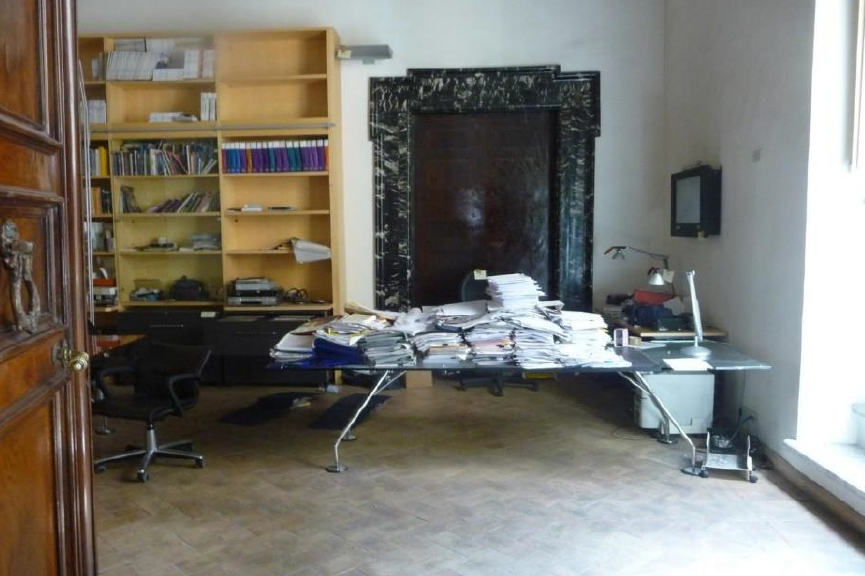
Gherardi subsequently developed the concept that was ultimately implemented, which involved a complete fresco of the ceiling and focused thematically on the Old Testament narrative of the Book of Esther. The painter selected four episodes significant to the narrative, which, against the backdrop of an illusionistic, trompe-l’œil architecture, adorn the vaulting of the hall. Reflected in the vault, the architecture opens up to a blue sky, creating an impression of airy height. The heavens are dominated by the allegorical theme of the triumph of truth over deception, an original and unique addition to an Esther cycle. The four scenes from the Book of Esther are not arranged chronologically in a specific reading order, but rather correspond thematically with the scene opposite them. The triumph of Mordecai and the faint Esther on the long sides of the hall depict the pardon and elevation of the two central Jewish protagonists by the Persian king. On the short sides of the hall, Esther’s coronation, clearly inspired by Veronese, and her subsequent banquet, where she exposes the king’s favorite, Haman, as the architect of a plot against her people, are juxtaposed. A link between the two themes is provided by the central allegory, which reiterates the coronation motif as well as the victory of truth over deception. In designing the allegorical figure of Truth, Gherardi drew inspiration from Cesare Ripa’s Iconologia: she is represented by a beautiful woman, clothed only in a white loincloth, holding a palm branch and a book in her left hand, while She presents the radiant sun in her raised right hand and simultaneously places her right foot on the globe – attributes that allude to the clarity, simplicity, and connection to reality of truth. Gherardi adds a golden chariot with a shell-shaped backrest as the throne of truth, which is guided upwards into the heavens by two putti on long ribbons. A third putto, hovering above the chariot, is about to crown truth, thus creating a reference to Esther, who, as the representative of truth, triumphs in the biblical story through her accusation of Haman. Accordingly, the chariot of truth rolls over the allegory of deception (Inganno), which carries as its attribute a snake hidden in flowers. (by Nina Niedermeier) In 2022, the European Heritage Project was initially able to acquire the first floor, the piano nobile, with almost 700 square meters. However, the circumstances surrounding the acquisition were somewhat mysterious. The seller changed several times during the negotiations. Upon finally taking possession, the European Heritage Project found the premises largely devastated. Office furniture had been overturned. Files and other documents were scattered everywhere, knee-deep in debris. Smashed computer monitors made walking dangerous. Apparently, a dubious group had fled the premises, taking only hard drives and documents with them.
In 2024, the majority of the second floor, along with some storage rooms on the ground floor, was also acquired. This brought the majority of the palazzo into the possession of the European Heritage Project. Renovation could then begin.
PRESENT USE
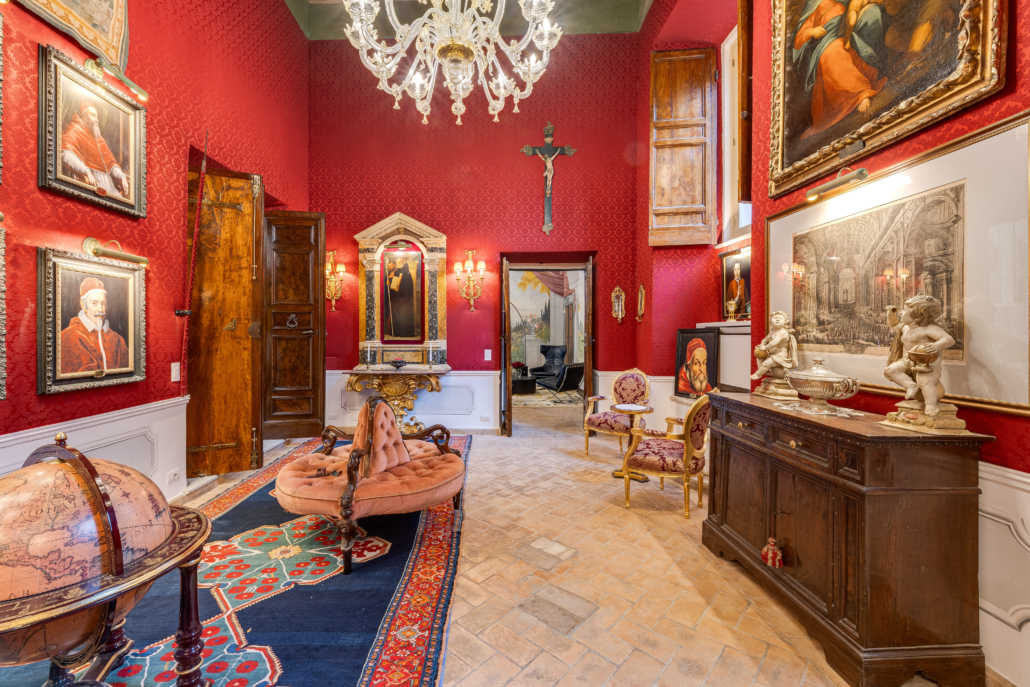
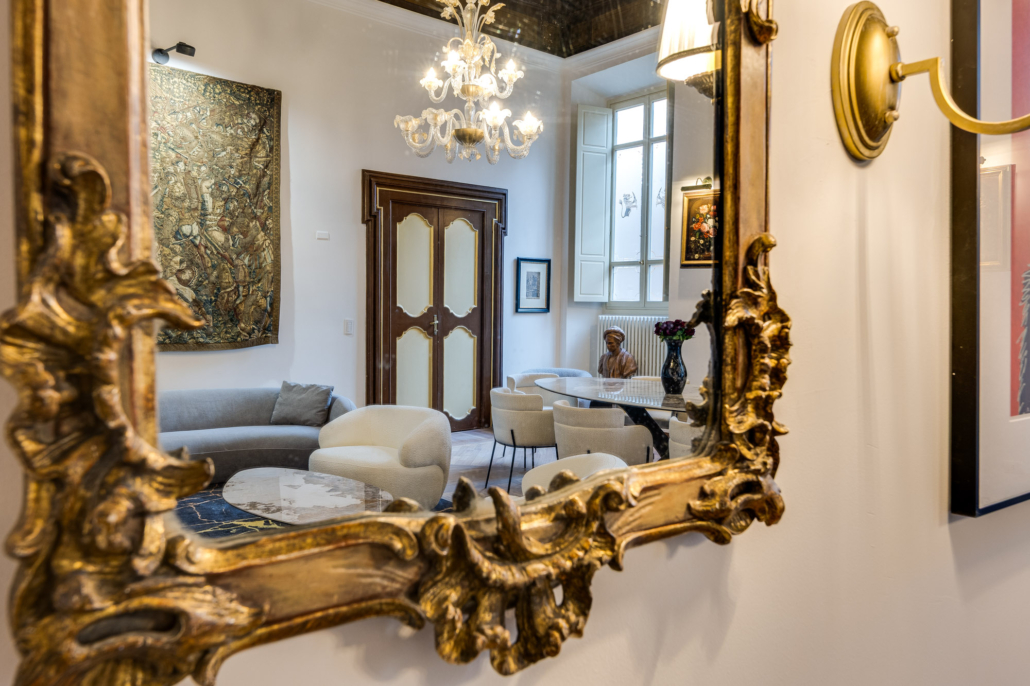
The Palazzo houses the Roman branch of the European Heritage Project and the Sacer ac Militare Ordine Constantianum Sancti Georgii on its main floor (Belle Etage). Receptions and festive dinners are held here, and contact is maintained with the Italian government and the Holy See. The main floor comprises reception, conference, and reception rooms. The second floor serves as accommodation and meeting space for guests of the European Heritage Project and the Order.
PURCHASE SITUATION
n 2022, the European Heritage Project was able to acquire the first floor, the piano nobile, comprising nearly 700 square meters. However, the circumstances surrounding the acquisition were somewhat mysterious. The seller changed several times during the negotiations. Upon finally taking possession, the European Heritage Project found the premises largely devastated. Office furniture had been overturned, and files and other documents were scattered knee-deep everywhere. Smashed computer monitors made walking dangerous. It was clear that a dubious group had fled the premises, taking only hard drives and documents with them.
In 2024, the majority of the second floor, along with some storage rooms on the ground floor, was also acquired. This brought the majority of the palazzo under the ownership of the European Heritage Project, and the renovation could begin.
n 2022, the European Heritage Project was able to acquire the first floor, the piano nobile, comprising nearly 700 square meters. However, the circumstances surrounding the acquisition were somewhat mysterious. The seller changed several times during the negotiations. Upon finally taking possession, the European Heritage Project found the premises largely devastated. Office furniture had been overturned, and files and other documents were scattered knee-deep everywhere. Smashed computer monitors made walking dangerous. It was clear that a dubious group had fled the premises, taking only hard drives and documents with them.
In 2024, the majority of the second floor, along with some storage rooms on the ground floor, was also acquired. This brought the majority of the palazzo under the ownership of the European Heritage Project, and the renovation could begin.


Videos:
The European Heritage Project acquires the Palazzo Nari a Sant’Eustachio.