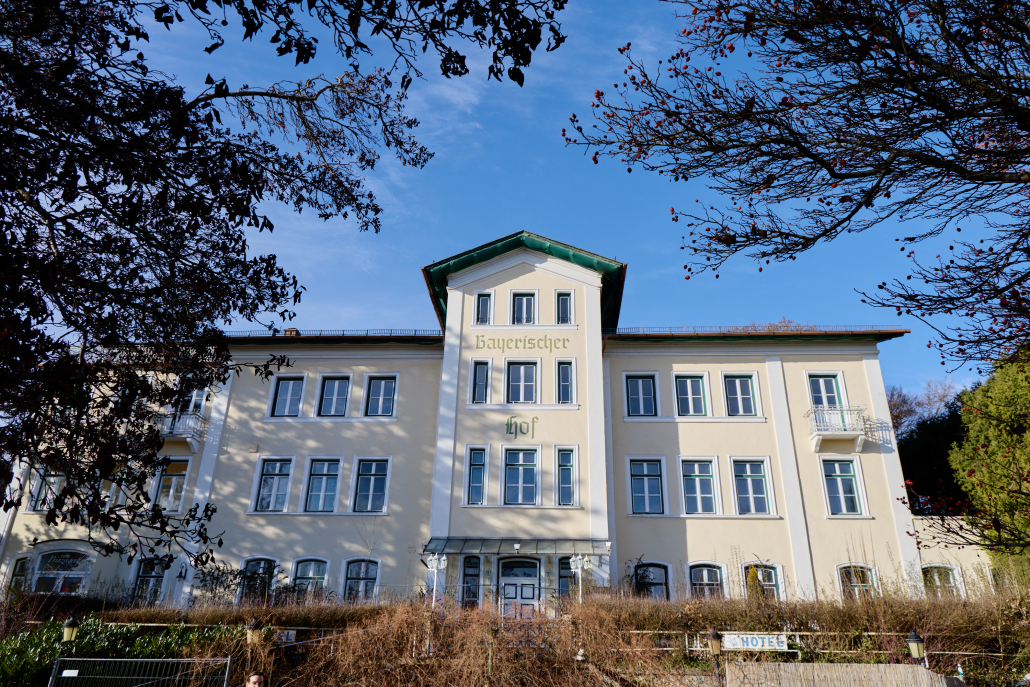
The Bayerischer Hof was designed by the eminent Bavarian architect Leo von Klenze and is linked to Klenze’s work as court architect to the Bavarian royal family. Klenze, who is best known for his classical buildings, had a decisive influence on the appearance of the building with his design. The Bayerischer Hof is thus one of Starnberg’s architecturally and historically significant buildings and reflects the prestige associated with the era.
Architecturally, the Bayerischer Hof is a three-storey building from the Wilhelminian period with classical influences. The clearly structured building, featuring a central projection, a gabled roof and a stately terrace with an open staircase, lends the building a dignified yet understated elegance. Extensions from the late 19th and early 20th centuries – including outbuildings, balconies and terraces – blend harmoniously into the original appearance and bear witness to the building’s continuous development.
Inside, the historic room layouts and functional areas reflect the building’s original use as a hotel. Vaulted cellars, former utility rooms and stables tell of a time when guests arrived by carriage, ice from Lake Starnberg was used for cooling, and the building was largely self-sufficient. The Bayerischer Hof was not only a place of accommodation, but also a social meeting place and part of the region’s cultural life.
Due to its great historical, architectural and urban significance, the Bayerischer Hof is now a listed building. It is regarded as one of the last largely preserved buildings from the Wilhelminian era around Bahnhofplatz and continues to shape the townscape of Starnberg to this day. Its history is closely linked to the town’s development, making it an important point of identification for residents and visitors alike.
The Bayerischer Hof thus symbolises Starnberg’s transformation from a small lakeside town into a significant city in the Munich area – whilst preserving the character and atmosphere of a bygone era.
The building had been in the Wittelsbach family’s possession since 1905. Owned by the Herzogliches Brauhaus Tegernsee, the ‘Hotelbetriebsgesellschaft Starnberg’ thoroughly renovated the building in 1952 without altering its architecture. The hotel has since passed into the ownership of the town of Starnberg. In 2025, the European Heritage Project was finally able to acquire the Bayerischer Hof from the town for a symbolic sum. In accordance with its principles, the EHP is committed to professionally renovating the listed historic building. A cosy café is planned for the ground floor, designed to give visitors the feeling of encountering the royalty of days gone by. The priority is to restore the Bayerischer Hof to its former glory and make it once again a historic landmark of the town.