The European Heritage Project by Peter Löw
  • About
    • THE INITIATOR
    • THE COMMITTEE
  • Strategy
    • RESTRUCTURING PLAN
    • THE CHARTER
  • Projects
    • The Projects
    • Project Overview
    • Chronology
  • Experience
  • News
  • EN
    • DE
    • FR
    • IT
  • Click to open the search input field Click to open the search input field Search
  • Menu Menu

Bayerischer Hof

At the Bayerischer Hof on Lake Starnberg,
I found moments to catch my breath,
far from the noise of the world.

freely adapted from Empress Elisabeth “Sissi” of Austria

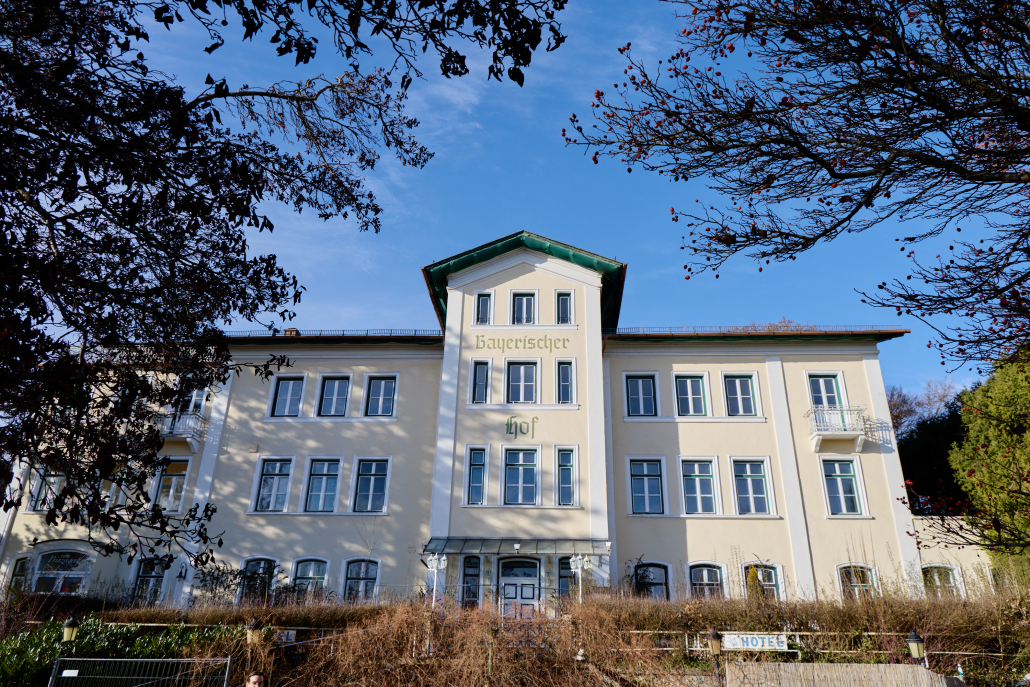
The Bayerischer Hof in Starnberg is one of the town’s most significant historic buildings and a defining testament to the early development of tourism and urban growth on Lake Starnberg. Built in 1864–65, the hotel was constructed during a period of economic revival, triggered by Starnberg’s connection to the railway network and the resulting surge in tourism. As a luxury hotel, the Bayerischer Hof served for decades as the premier destination for travellers, summer visitors and prominent guests.

In 2026, the European Heritage Project was able to acquire the Bayerischer Hof from the town of Starnberg and is committed to professionally renovating the historically valuable building.

MORE INFORMATION

The Bayerischer Hof was designed by the eminent Bavarian architect Leo von Klenze and is linked to Klenze’s work as court architect to the Bavarian royal family. Klenze, who is best known for his classical buildings, had a decisive influence on the appearance of the building with his design. The Bayerischer Hof is thus one of Starnberg’s architecturally and historically significant buildings and reflects the prestige associated with the era.
Architecturally, the Bayerischer Hof is a three-storey building from the Wilhelminian period with classical influences. The clearly structured building, featuring a central projection, a gabled roof and a stately terrace with an open staircase, lends the building a dignified yet understated elegance. Extensions from the late 19th and early 20th centuries – including outbuildings, balconies and terraces – blend harmoniously into the original appearance and bear witness to the building’s continuous development.
Inside, the historic room layouts and functional areas reflect the building’s original use as a hotel. Vaulted cellars, former utility rooms and stables tell of a time when guests arrived by carriage, ice from Lake Starnberg was used for cooling, and the building was largely self-sufficient. The Bayerischer Hof was not only a place of accommodation, but also a social meeting place and part of the region’s cultural life.
Due to its great historical, architectural and urban significance, the Bayerischer Hof is now a listed building. It is regarded as one of the last largely preserved buildings from the Wilhelminian era around Bahnhofplatz and continues to shape the townscape of Starnberg to this day. Its history is closely linked to the town’s development, making it an important point of identification for residents and visitors alike.
The Bayerischer Hof thus symbolises Starnberg’s transformation from a small lakeside town into a significant city in the Munich area – whilst preserving the character and atmosphere of a bygone era.
The building had been in the Wittelsbach family’s possession since 1905. Owned by the Herzogliches Brauhaus Tegernsee, the ‘Hotelbetriebsgesellschaft Starnberg’ thoroughly renovated the building in 1952 without altering its architecture. The hotel has since passed into the ownership of the town of Starnberg. In 2025, the European Heritage Project was finally able to acquire the Bayerischer Hof from the town for a symbolic sum. In accordance with its principles, the EHP is committed to professionally renovating the listed historic building. A cosy café is planned for the ground floor, designed to give visitors the feeling of encountering the royalty of days gone by. The priority is to restore the Bayerischer Hof to its former glory and make it once again a historic landmark of the town.

Video posts:

The European Heritage Project has acquired a depiction of Munich painted by the artist Bernardo Bellotto, also known as Canaletto, during his time in the city on the Isar. In addition, a preliminary sketch and an engraving, which was probably produced shortly after the painting, were also acquired. Through the acquisition of these works, the European Heritage Project has ensured that a part of Bavarian cultural history remains in the region.


© Copyright - The European Heritage Project Protected as part of the UNESCO World Heritage
  • Link to Youtube
  • Imprint / Legals
  • Data Protection Policy
Scroll to top Scroll to top Scroll to top

We use cookies on this website. Some are essential, while some help personalise content, measure usage for us to provide a better and safer experience.

Accept cookiesPersonalise cookies

Cookie and Privacy Settings


How we use cookies

We may request cookies to be set on your device. We use cookies to let us know when you visit our websites, how you interact with us, to enrich your user experience, and to customize your relationship with our website.

Click on the different category headings to find out more. You can also change some of your preferences. Note that blocking some types of cookies may impact your experience on our websites and the services we are able to offer.

Essential Website Cookies

These cookies are strictly necessary to provide you with services available through our website and to use some of its features.

Because these cookies are strictly necessary to deliver the website, refusing them will have impact how our site functions. You always can block or delete cookies by changing your browser settings and force blocking all cookies on this website. But this will always prompt you to accept/refuse cookies when revisiting our site.

We fully respect if you want to refuse cookies but to avoid asking you again and again kindly allow us to store a cookie for that. You are free to opt out any time or opt in for other cookies to get a better experience. If you refuse cookies we will remove all set cookies in our domain.

We provide you with a list of stored cookies on your computer in our domain so you can check what we stored. Due to security reasons we are not able to show or modify cookies from other domains. You can check these in your browser security settings.

Other external services

We also use different external services like Google Webfonts, Google Maps, and external Video providers. Since these providers may collect personal data like your IP address we allow you to block them here. Please be aware that this might heavily reduce the functionality and appearance of our site. Changes will take effect once you reload the page.

Google Webfont Settings:

Google Map Settings:

Google reCaptcha Settings:

Vimeo and Youtube video embeds:

Privacy Policy

You can read about our cookies and privacy settings in detail on our Privacy Policy Page.

Data Protection Policy
Adapt cookiesReject all cookies



