

“I want to make Munich a city that does such honour to Germany that no one can say they know Germany if they haven’t seen Munich! “
King Ludwig I
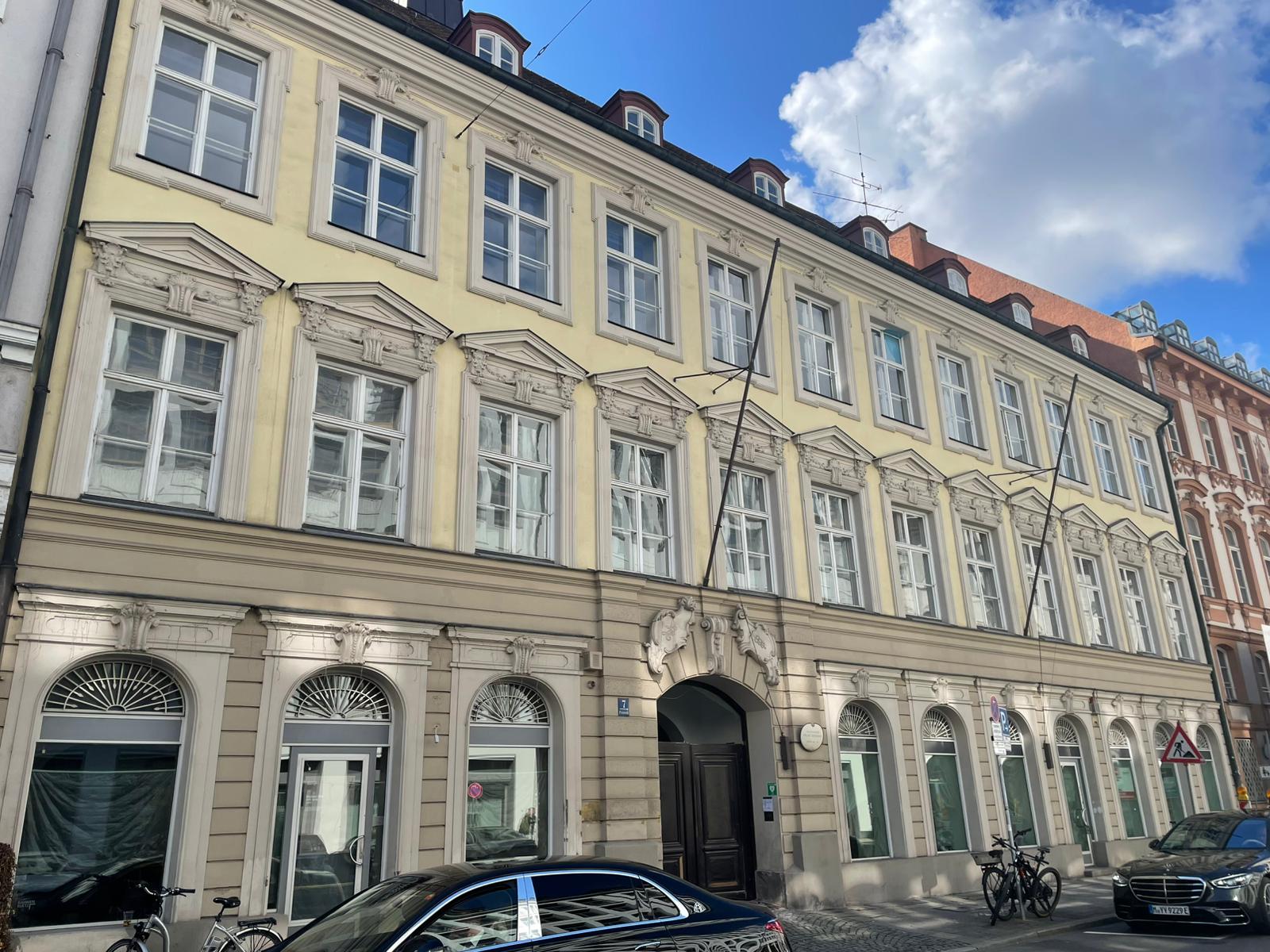
Only a few buildings in Munich’s historic old town survived the air raids of 1944/45. One of them is Gruber’s Stadtpalais, built in 1856 on the former Wallstraße in the immediate vicinity of Maximilianstraße.The old, second city wall of Munich’s inner city still ran along this site in the Middle Ages, the remains of which in the palace’s garden tell of that time. When the ramparts of the city fortifications that were later built here were finally ground down under King Ludwig I and, together with Maximiliansstraße and the new gardens of the Ring, were redesigned into a prestigious quarter, the Biedermeier palace with its tranquil garden also came into being in the midst of the turbulent city.
In 2018, the European Heritage Project was able to acquire this gem from Caritas after the death of the owner and comprehensively renovate it. Today, the European Heritage Project uses it as a German branch and as a representative exhibition space for its own art collections.

PURCHASE SITUATION
The building was owned by an elderly lady who used the rooms herself until her death. Due to her advanced age, however, necessary maintenance measures had not been carried out to the necessary extent for decades. When the lady died in 2017, she bequeathed the property to the German branch of Caritas. For them, however, the building was unsuitable for use, as the floor areas were too small and the investment backlog and the necessary investment requirements were too high. When the European Heritage Project learned of the intention to sell, several investors, mainly international ones, had already expressed their interest. However, they intended to divide the property into condominiums and sell it to foreign private individuals as a “pied-à-terre”. This would have destroyed the original idea of use. In intensive talks, the European Heritage Project succeeded in dissuading Caritas from the idea of breaking up the property in order to preserve the palace as a unit. In 2018, the property was finally acquired.
HISTORY
After Louis the Austere moved his residence to Munich in 1255, a second city fortification wall became necessary, which for the first time included parts of the later Maximilianstrasse. However, the area of Stollbergstrasse was still outside the city area at that time. Even the Zwinger wall built in the 15th century did not reach there. It was not until the ramparts were built in the 17th century that the area of today’s Stollbergstraße was also covered. When Munich’s fortress status was revoked at the end of the 18th century, the ramparts began to be dismantled. In their place, among other things, Wallstraße, later Stollbergstraße, was developed. In the course of the redesign of Munich’s city centre by King Ludwig I, not only was the new Maximiliansstrasse built in the Italian “Maximilian” style, but the former ramparts were also rededicated. Especially in the immediate vicinity of Maximilianstrasse, numerous representative city villas were built for the upper middle classes. For example, in 1855 Julius Gruber, the partner of the renowned Palmersche Hofbuchhandlung , commissioned the construction of a stately new city palace in Wallstraße from Friedrich Bürklein, who was probably the most respected architect in Munich at the time. Bürklein, a pupil of Friedrich von Gärtner and a royal building councillor since 1852, was not only the mastermind behind the new Maximilianstraße, but also the designer of the Munich railway station building and the Maximilianeum. His design of the building was based on a square ground plan. Gruber’s Stadtpalais was finally completed in 1858. It initially consisted of a three-storey main building with a city garden with a small tea house at the rear. In the following years, there were numerous extensions. In 1890, for example, the lower storey on the garden side was raised. On the street side, three rooms were added to the main house. At the end of the 19th century, the bay windows and staircase windows were fitted with stained glass.
ARCHITEKCTURE
The façade of the building is reminiscent of the Munich Biedermeier style. The strict division into four storeys, each with five windows, is emphasised by a central bay window with fluted column elements that extend from the 1st to the third storey. A central pointed tower with a gilded wind vane completes the façade towards the top. Attached to the front as decorative ornaments are four “Maximilian roses”, as they adorn the large buildings on nearby Maximilianstraße. The ensemble is surmounted by the tower of the staircase, which is placed on the side and breaks the strict symmetry. The historic stained glass windows in the bay windows have been largely preserved. The entrance area of the property reflects the representative character of the building. Ornamental cement tiles adorn the floors, stucco the ceilings. Particularly striking is the spiral staircase that connects the ground floor with the 4th floor. The transparent design of the domed roof seems particularly successful here, allowing the light to enter unhindered and thus giving the staircase an unexpected lightness. In the rooms on the ground floor and the first floor, it was possible to preserve most of the historical fixtures, while they had already been mostly removed on the higher floors. The small park behind the house is a special jewel in Munich’s city centre. Facing south-east, it concentrates the light, especially until the afternoon, and offers every visitor peace and relaxation in the otherwise hectic city centre. The small tea house with its lovely Biedermeier paintings has been preserved in its entirety and reflects the reception of originally aristocratic garden culture into bourgeois life.
STRUCTURAL CONDITION AT TIME OF ACQUISITION & RESTAURATION
The property was occupied by the owner, an elderly lady, herself until 2017. Due to the lady’s advanced age, necessary maintenance measures had been omitted for a longer period of time. This required extensive renovation. In the course of the work, the entire roof was renewed, the electrical installations were replaced and the sanitary facilities were brought into a contemporary condition. The parquet floors, some of which are still original, were professionally restored, and the doors and windows, where still original, were refurbished. The entire heating system was replaced by a low-energy heating system. The flats were also equipped with underfloor heating. The façade was repaired and upgraded in accordance with the requirements of the preservation order.
PRESENT USE
The historic living spaces on the ground floor and first floor are being used again as living spaces. The floors above are home to part of the European Heritage Project’s art collections, especially modern and contemporary artworks. The exhibition rooms also serve as a dependence of the European Heritage Project in Germany, where political discussions as well as cultural events take place on a regular basis.
THINGS TO KNOW AND CURIOSTIES
Mozart at Palais Seinsheim
The life and work of Wolfgang Amadeus Mozart are closely linked to the city of Munich. Two of his magnificent works were composed in Munich, then the royal residence: On January 13, 1775, the premiere of “La finta giardiniera” took place, and on January 29, 1781, the opera “Idomeneo” premiered at the Cuvilliés Theatre.
During the winter of 1780 and 1781, Mozart stayed for several weeks in Munich’s old town, specifically at Prannerstraße 7, the current headquarters of the European Heritage Project, with his friend and admirer, the young Maximilian Clemens von Seinsheim, just steps from the courtly buildings of the Residence. From there, he oversaw the preparations for the premiere of his new opera, Idomeneo, which he had composed on commission from Elector Karl Theodor. The performance was to take place in the magnificent Cuvilliés Theatre, the baroque court theatre of the Munich Residence. The Bavarian Elector had clear ideas about how he wanted the carnival opera he had commissioned to be performed. And that included a happy ending. But Mozart despaired of the castrato Vincenzo Del Prato: he was simply incapable of singing. The day before yesterday, he had sung so badly it was a disgrace. And the ballet master also provoked his displeasure.
However, Mozart had friends in Munich who supported his artistic endeavors. The Bavarian court music director, Count Johann Anton von Seeau, arranged a last-minute orchestral rehearsal of Idomeneo in his residence. Only a few select individuals attended the rehearsal, including, of course, Mozart’s friend Count von Seinsheim. At the end of the rehearsal, Count von Seinsheim said to the musical genius: “I assure you that I had very high expectations of you, but I certainly didn’t expect this.” One could almost say: Had Maximilian Clemens von Seinsheim been in charge back then, Munich, not Vienna, would have become Mozart’s city.
The grand rooms on Prannerstrasse offered Mozart the ideal environment to work on completing his opera and, at the same time, to become acquainted with the illustrious society from all over Europe. Just a few streets away, rehearsals were underway at the Cuvilliés Theatre. Mozart hurried almost daily from Prannerstrasse to the Residenz to work with the Kapellmeister, musicians, and singers.
During these weeks, courtly splendor in Munich merged with the intense work of a young composer at the height of his creative powers. When Mozart returned to his rooms on Prannerstrasse late at night, a candle often burned long over the open scores. There, he made the final changes to an opera that would have its glorious premiere at the Cuvilliés Theatre just a few weeks later.
In 1790, Mozart came to Munich one last time on his journey to the coronation of Leopold II in Frankfurt. He gave a concert at the Residenz for the enthusiastic King of Naples.
Today, the newly renovated Palais Seinsheim houses the “Mozart Hall”, which commemorates the musical genius’s stays in this house.
The Illuminati and the Seinsheim Palace
The Order of the Illuminati was founded in 1776 by Adam Weishaupt in Ingolstadt. The order was not a conspiracy in the modern sense, but rather an Enlightenment-era secret society that sought to prioritize reason over privilege and superstition. Its aim was to address social injustices and spread Enlightenment ideas through education, networking, and political reform. Its structure was heavily inspired by Freemasonry.
According to lists of historical members, Maximilian Joseph Clemens Count von Seinsheim was a prominent member of the Order of the Illuminati, where he used the name “Alfred.” He was part of a group of influential nobles and officials (including figures such as Count Seeau and Count Preysing). The Illuminati in the Electorate of Bavaria were particularly active in areas where the desire for reform intersected with the established administration—precisely the milieu in which Seinsheim worked. Indeed, sources indicate that some of his most important associates and courtiers also joined the order or were at least closely associated with this Enlightenment movement. Thus, tutors, teachers, and trusted advisors in the Seinsheim household were often Illuminati or sympathizers.
The Order facilitated contacts between the university, the court administration, and aristocratic reform circles. While Count Seinsheim’s political role officially served the Elector’s projects, within the Order he championed enlightened reform ideas. In the rooms on Prannerstrasse, passionate discussions often took place about how education and rational laws could improve the state.
In 1785, the Bavarian state declared the Order—along with the Freemasons—banned because its growing network was considered dangerous. Although promoting rational thought was not a crime, the conservative court faction saw it as a threat to the established power. Seinsheim and other former members found themselves in an awkward position: they had to publicly distance themselves while simultaneously protecting their networks. The fact that these “reform circles” did not simply disappear after the ban demonstrates how deeply entrenched they had already become in the administration and court society.
Maximilian Joseph Clemens Count von Seinsheim was not an occultist or a world conspirator, but rather a representative of the enlightened nobility of the late 18th century who belonged to a genuine historical secret society. He was a classically reform-oriented thinker who skillfully involved members of his own household and close circle of associates through the Order. Even after the Society was banned, he continued his pragmatic political career.
Seinsheim Palace – A Political Hub
Seinsheim Palace was of central political importance not only because of its location – directly opposite the Estates Assembly and in the immediate vicinity of the Residence. Above all, its inhabitants, the Counts of Seinsheim, were closely connected to the political life of Bavaria for generations. Many an important political decision was made behind the magnificent facades of Prannerstrasse.
Since the end of the 17th century, the Counts of Seinsheim had been known for their political activities. Maximilian Franz Count von Seinsheim (1681–1737) was President of the Court Council in Bavaria and Privy Councilor at the Bavarian court. He is considered the founder of the family’s political rise in the 18th century. As a close advisor to the court, he shaped administrative policy in the Electorate of Bavaria. He systematically prepared both the secular and ecclesiastical careers of his sons, thus laying the foundation for the family’s influence in state and church.
Joseph Franz Maria Ignaz Count von Seinsheim (1707–1787) was one of the most important politicians of the family, serving as a Bavarian statesman, Privy State and Conference Minister, Grand Master of the Court to the Electress, Minister of War, and later Minister of Foreign Affairs, as well as President of the Bavarian Academy of Sciences. He was the central figure at the Munich court under Elector Maximilian III Joseph and was involved in shaping domestic policy, court organization, and diplomacy. He was a classic Enlightenment official of the 18th century—educated, well-connected, and politically influential.
Adam Friedrich Count von Seinsheim (1708–1779) was Prince-Bishop of Würzburg (from 1755) and Prince-Bishop of Bamberg (from 1757), as well as President of the Court Chamber and the Court War Council, and a diplomat of the Holy Roman Empire. He was thus not only a churchman but also a territorial ruler, governing two ecclesiastical principalities simultaneously. He implemented reforms in the education system and significantly advanced the University of Bamberg. He had to ensure political stability during the Seven Years’ War. He was one of the most important prince-bishops of the 18th century and particularly crucial for the connection between religion, politics, and state.
Maximilian Joseph Clemens, Count of Seinsheim (1751–1803), son of Joseph Franz Maria Ignaz, belonged to an important segment of the enlightened Bavarian nobility. While his political activities were less official than those of his father, he wielded considerable influence through his networks and his proximity to enlightened circles. He represents the transition from the absolutist court nobility to the enlightened reform nobility.
After his father’s death, Maximilian Joseph Clemens Seinsheim experienced a rise in social standing with his appointment in 1788 as Zweibrücken’s envoy to the Imperial Diet in Regensburg. The previous year, the Seinsheim couple had deepened their acquaintance in Strasbourg with the amiable and jovial Prince Max Joseph, the younger brother of the aforementioned duke. No one could have foreseen what the bond of trust between the two couples would one day mean for Prince Ludwig of Palatinate-Zweibrücken, born in 1786, and Karl August Seinsheim, two years his senior, as well as for his siblings in distant Munich.
After the years of turmoil and suffering during the Revolutionary Wars, some time passed before the new Elector Max IV Joseph made his ceremonial entry into Munich on March 12, 1799. He had previously returned with his family from Ansbach, their last place of exile, and had been staying incognito in Augsburg. August Karl Seinsheim, the youngest son of the family, recalled: In February 1799, Elector Karl Theodor of Palatinate-Bavaria suffered a stroke during an evening meal just a few days before February 16. According to his mother’s records, the stroke occurred on February 12, and the Elector immediately lost his speech. He died at 3:20 p.m. on February 16.
The first news of this dramatic event was brought to the main family’s palace, located between Paradeplatz and Prannerstraße, by the chamber page Friedrich Seinsheim from the Wenger branch of the family. While a messenger sent by Maximilian Joseph Clemens Seinsheim delivered the alarming news to the heir to the throne in Ansbach, Prussia, his cousin, a chamber page, kept everyone informed of the situation by constantly running back and forth between the Residenz and the palace. In this way, the Seinsheim family, to the best of their ability, helped to prevent the annexation of Bavaria by Austria.
Immediately after the death of Karl Theodor, the new Elector Max IV Joseph went to the family palace of his supporter, where he was received with jubilation and warmth. He was particularly moved by the children’s theatrical performance, which August Karl had decorated and lit in the style of the stage sets from “The Magic Flute.” After the curtain rose, the artist’s siblings sang a joyful “Vivat!” Max IV Joseph knelt on the floor and expressed his delight as if he had been given a grand celebration. He felt as honored by this affectionate performance as he would at a costly official banquet.
Maximilian’s son, Johann Franz Maria Arbogast, Count of Seinsheim (1775–1830), was a Privy Councillor and a member of the Bavarian Estates Assembly (an early parliament). He was part of Bavaria’s early constitutional development and involved in the political reorganization after 1800. He already belonged to the generation that transitioned from absolutism to the modern state of Bavaria.
The Counts of Seinsheim were not “great military commanders,” but primarily power managers of the state, serving as ministers, diplomats, church dignitaries, and reformers. They belonged to the elite that shaped Bavaria politically, culturally, and administratively in the 18th century.


Videos:
Das European Heritage Project hat eine Darstellung Münchens erworben, die der Künstler Bernardo Bellotto, auch Canaletto genannt, während seiner Zeit in der Isarmetropole malte. Außerdem konnte eine Vorzeichnung und ein Stich, der wahrscheinlich kurz nach dem Bild entstand, erworben werden. Durch den Erwerb der Werke konnte das European Heritage Project den Verbleib eines Teils der bayerischen Kulturgeschichte in der Region sichern.




