The European Heritage Project by Peter Löw
  • About
    • THE INITIATOR
    • THE COMMITTEE
  • Strategy
    • RESTRUCTURING PLAN
    • THE CHARTER
  • Projects
    • The Projects
    • Project Overview
    • Chronology
  • Experience
  • News
  • EN
    • DE
    • FR
    • IT
  • Click to open the search input field Click to open the search input field Search
  • Menu Menu

Villa Attwenger

“Ischl is my heaven on earth.”

loosely based on Emperor Franz Joseph I

Where the River Traun flows right through the centre of Bad Ischl, at Lehárkai 12, stands one of the town’s oldest town houses: Villa Attwenger. It was built before 1404 as the home of the salt workers. The house is therefore one of the oldest secular buildings in Bad Ischl.

In the mid-19th century, the house passed to the Attwenger family, who turned it into an inn. Today, the villa is a listed building. The European Heritage Project was able to acquire Villa Attwenger in October 2026.

MORE INFORMATION

When you step inside the villa, you are transported to another era. The old rooms have been preserved in their original condition, and you can sense the atmosphere of centuries past. Outside, the garden stretches right down to the River Traun, along which salt from the Salzkammergut used to be shipped. Right next door stands Franz Lehár’s villa. The composer of *The Merry Widow* spent many summers there and died in Bad Ischl in 1948. Today, his villa is a museum. Here, you can experience the history of the imperial town of Bad Ischl at first hand.
The villa owes its name to its wines: because such fine wines were served there, it soon became known as the ‘Weinhaus Attwenger’. The owner, Johann Nepomuk Attwenger, was both a teacher and an innkeeper, a co-founder of the Bad Ischl Savings Bank and a school friend of Anton Bruckner.
Bruckner continued to visit from time to time later on. From 1863 onwards, he travelled regularly to Ischl to play the organ at celebrations marking Emperor Franz Joseph’s birthday and at other festivities of the imperial family. In 1890, he also played at the wedding of the Emperor’s daughter, Marie Valerie. During these visits, he would always pop in to see his childhood friend’s family.

PURCHASE SITUATION

The European Heritage Project was able to acquire the listed Attwenger House in October 2026.

ESTATE FACTS AND FIGURES

The house, built in 1404, is a listed building.

HISTORY

The history of Villa Attwenger dates back to the heyday of the Salzkammergut, when ‘white gold’ shaped the town of Bad Ischl.
The building was originally constructed as what was known as a ‘Salzfertigerhaus’. At that time, the Salzfertiger were among the wealthiest citizens of the market town of Ischl: they held the right to dry, pack and sell the salt produced in the salt works, and to ship it down the River Traun. Its location by the river was ideal for this, as it was from here that the salt barges set off downstream along the Traun.
The house stands on the right bank of the Traun, just a few steps from the centre. This area used to be known simply as ‘Am Gries’, after the gravel and sand on the riverbank. It was only later that the riverbank became a road. From 1843 it was called Obere Quellgasse, from 1881 Kronprinz-Rudolf-Kai and from 1922 Stelzhamerkai. Since 1930 it has borne the name of Franz Lehár, whose villa stands a few houses further along.
The house was also a place of rest from very early on. According to tradition, it was mentioned as early as 1618 as a ‘Rastliche Gastgebsbehausung’, that is, an inn for travellers. This makes it one of the oldest inns in the town.
The house owes its name – still in use today – to Johann Nepomuk Attwenger (d. 1893). He worked as a teacher in Ischl from 1847 and subsequently held a post at the Imperial and Royal District Office. In 1854, he became the owner of the house through marriage. The Attwenger family continued to run it as an inn, and it soon became renowned for its wines: the Salzfertigerhaus became the ‘Weinhaus Attwenger’. Johann Nepomuk Attwenger was one of the town’s most respected men and a co-founder of the Ischl Savings Bank.
The house gained particular significance through a friendship. Attwenger and Anton Bruckner had known each other since their joint teacher training at the Präparandie in Linz around 1840. At his friend’s invitation, Bruckner visited Ischl for the first time in the summer of 1863. Until the 1890s, he was a frequent guest of the Attwenger family, who treated him to his favourite dishes and Linzer Torte. The two friends are said to have corresponded regularly, but these letters were lost in the floods of 1897. A commemorative plaque on the façade still commemorates Bruckner’s visits today.
According to tradition, other famous guests from the imperial city also stayed at the house, such as Johann Nestroy and Johannes Brahms.
For generations, the Attwenger House remained a popular meeting place for locals and summer visitors to Ischl. The historic rooms have been preserved largely in their original condition to this day. Situated in the immediate vicinity of the Lehár Villa and overlooking the River Traun, the house, like almost no other, bridges the city’s different eras: the salt trade of the early modern period, Ischl’s inn culture and the great musical history of the 19th century.

INTERESTING FACTS AND CURIOSITIES

A friendship for life

It all began in Linz. Around 1840, two young men were training to become teachers at the teacher-training college there: Anton Bruckner and Johann Nepomuk Attwenger. The fellow students became friends, and that remained the case for half a century. In 1847, Attwenger moved to Ischl to take up a teaching post. In 1854, following his marriage, he became the owner of the old wine house on the banks of the Traun, which still bears his name today.
The Emperor’s Organist
In the summer of 1863, Bruckner accepted his friend’s invitation to visit Ischl for the first time. It marked the beginning of a long association with the imperial town. In the decades that followed, Bruckner would regularly play the organ at Ischl’s parish church whenever the imperial family held their celebrations there. During those summers, he preferred to stay with the Attwenger family. Here, the great composer found peace, company and good food: the Attwengers spoiled him with his favourite dishes and Linzer Torte.

A celebration for the Emperor’s daughter

Bruckner experienced the highlight of his years in Ischl on 31 July 1890. Archduchess Marie Valerie, the youngest daughter of Emperor Franz Joseph and Empress Elisabeth, was married in the parish church. She held Bruckner in the highest regard. He sat at the organ, and his playing on that day remains legendary in Ischl to this day. His sketches for the improvisation have been preserved and were brought to life again a century later.

Letters swept away by the river

Despite the distance between Vienna and Ischl, the two friends wrote to one another regularly. Nothing of this correspondence remains: during the great flood of 1897, the River Traun – on the banks of which the house had stood for centuries – swept the letters away. Bruckner and Attwenger saw each other for the last time in 1892. A year later, Johann Nepomuk Attwenger died in Ischl; Bruckner followed him in 1896.

Traces of Bruckner in the house

The memory of the famous guest lives on in the house. His parlour features a bronze relief of the composer, and a commemorative plaque on the façade marks his stays there. Both were jointly donated by the Ischl Bruckner Society and the Attwenger family. Anyone standing in front of the Attwenger House today is standing in a place where one of Austria’s greatest composers found friendship, hospitality and a sense of home.

Stories from the Attwenger House

A Rest Stop on the Traun

A house with over 400 years of history collects stories. One of them tells how the Salzfertigerhaus became an inn. From here, on the banks of the Traun, Ischl’s salt set off on its journey downstream. The salt merchants often had to wait a long time until the salt ships were loaded and ready to sail. According to tradition, the house thus naturally became a place of rest: people waited, ate and drank, and stayed the night. It is said to have been mentioned as early as 1618 as the ‘Rastl’sche Gastgebsbehausung’, an inn for travellers. This makes the Haus Attwenger one of the oldest inns in the town.

Nestroy’s favourite spot

Johann Nestroy, the great Viennese comedy writer and actor, loved Ischl. He spent many summers here and eventually bought his own villa in the town. It is said that he had his favourite table at the Haus Attwenger, in the most beautiful spot in the house. Until quite recently, guests were shown the bench on which the poet is said to have sat. It is easy to imagine him sitting there with a glass of wine, enjoying the view across the Traun and perhaps working on a new punchline.

A summer retreat

When Ischl became the Emperor’s summer residence in the 19th century, the arrival of the court brought the wider world to the small town: composers and poets, painters, actors and singers spent the summer months here. The wine house on the banks of the Traun, just a few steps from the centre yet quietly nestled amongst the greenery, became a popular meeting place during this period. According to tradition, many a famous guest from the imperial era stopped off here. Later, Franz Lehár, one of the most famous composers of his time, moved in right next door on the quay. Standing in front of the house today, it is easy to imagine the conversations, the music and the clinking of glasses from those summers.

ARCHITECTURE

One house, two eras

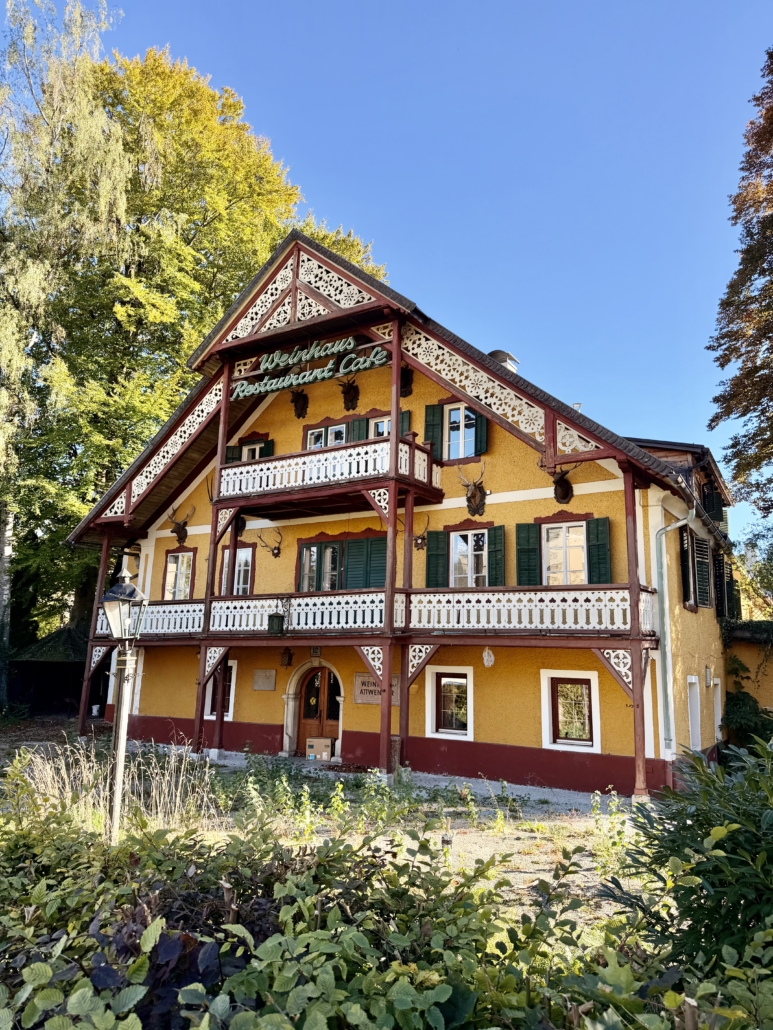
The Attwenger House at Lehárkai 12 is a listed town house on the right bank of the River Traun. It reflects two distinct eras: the core of the building probably dates from the 15th century, whilst its external appearance is from the 19th century. The Ischl Local History Society therefore describes it as both a ‘villa and a town house’.
It is not known who commissioned the house. The client was a salt producer from Ischl, but his name is unknown. Nor has the name of the master builder been recorded.
In the 19th century, Ischl became the Emperor’s summer residence. Numerous villas were built along the River Traun at that time, mostly designed and built by local master builders and often in the so-called Swiss-style. The old Salzfertigerhaus was also given a new look during this period. Exactly when and by whom is not known. However, historical postcards from before 1910 already show the house with its present-day gable
The façade facing the River Traun is richly decorated:
Roof and gable: The steep gable-roof extends far beyond the wall of the house. The gable boards and gable triangle are adorned with fretwork featuring recurring rosettes and star motifs.
Woodwork: Posts, beams and ornate supports, painted reddish-brown, support the projecting roof and structure the façade.
Balconies: Two balconies are situated one above the other, both with finely carved wooden balustrades. Old postcards show open wooden verandas in this spot.
Plaster and windows: Ochre-yellow plaster, dark red window frames with curved canopies and green wooden shutters characterise the wall surfaces.
Entrance: A round-arched entrance door is situated in the centre of the ground floor.
Side wings: To the left, a lower section with its own, flatter roof adjoins the main building.
The interior
Inside, the historic rooms have been preserved in their original condition. These include a wood-panelled parlour.
Listed building
The house is listed as the ‘Bürgerhaus, Weinhaus Attwenger’. It is one of the few surviving salt workers’ houses in Bad Ischl and serves as a prime example of how an early modern town house was redesigned in the 19th century in the style of the Ischl summer villas.

Gallery

Project Gallery

Video posts:

The European Heritage Project has acquired a painting of Munich created by the artist Bernardo Bellotto, also known as Canaletto, during his time in the city on the Isar. In addition, a preparatory sketch and an engraving, which was probably produced shortly after the painting, were also acquired. By acquiring these works, the European Heritage Project has ensured that part of Bavaria’s cultural history remains in the region.


© Copyright - The European Heritage Project Protected as part of the UNESCO World Heritage
  • Link to Youtube
  • Imprint / Legals
  • Data Protection Policy
Scroll to top Scroll to top Scroll to top

We use cookies on this website. Some are essential, while some help personalise content, measure usage for us to provide a better and safer experience.

Accept cookiesPersonalise cookies

Cookie and Privacy Settings


How we use cookies

We may request cookies to be set on your device. We use cookies to let us know when you visit our websites, how you interact with us, to enrich your user experience, and to customize your relationship with our website.

Click on the different category headings to find out more. You can also change some of your preferences. Note that blocking some types of cookies may impact your experience on our websites and the services we are able to offer.

Essential Website Cookies

These cookies are strictly necessary to provide you with services available through our website and to use some of its features.

Because these cookies are strictly necessary to deliver the website, refusing them will have impact how our site functions. You always can block or delete cookies by changing your browser settings and force blocking all cookies on this website. But this will always prompt you to accept/refuse cookies when revisiting our site.

We fully respect if you want to refuse cookies but to avoid asking you again and again kindly allow us to store a cookie for that. You are free to opt out any time or opt in for other cookies to get a better experience. If you refuse cookies we will remove all set cookies in our domain.

We provide you with a list of stored cookies on your computer in our domain so you can check what we stored. Due to security reasons we are not able to show or modify cookies from other domains. You can check these in your browser security settings.

Other external services

We also use different external services like Google Webfonts, Google Maps, and external Video providers. Since these providers may collect personal data like your IP address we allow you to block them here. Please be aware that this might heavily reduce the functionality and appearance of our site. Changes will take effect once you reload the page.

Google Webfont Settings:

Google Map Settings:

Google reCaptcha Settings:

Vimeo and Youtube video embeds:

Privacy Policy

You can read about our cookies and privacy settings in detail on our Privacy Policy Page.

Data Protection Policy
Adapt cookiesReject all cookies

