
“I shall not rest,
until Munich looks like Athens.”
King Ludwig I
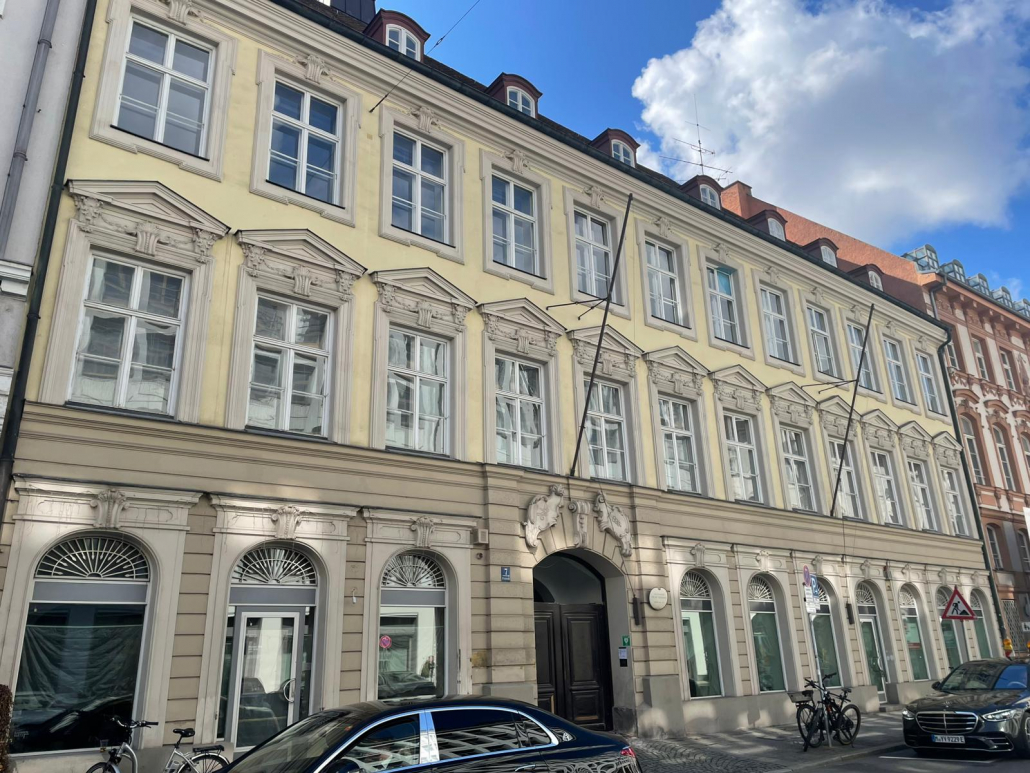
In the heart of Munich’s Old Town, just a few steps from the Frauenkirche, at Prannerstraße 7, stands an architectural gem with a rich history: the Palais Seinsheim. The palace was built around 1754 and is one of the city palaces of the Kreuzviertel, the former residential quarter of the Bavarian nobility. It is one of the largest and most significant townhouses of Munich’s Rococo period and remains to this day a striking example of aristocratic domestic culture in the royal capital.
Those passing by Prannerstraße often have no idea what cultural and historical heritage lies hidden behind the light-coloured façade. Inside, preserved stucco ceilings, mirrored panelling and former reception rooms still bear witness to the splendour of bygone days.
In 2025, the European Heritage Project was able to acquire the historic townhouse from the Bavarian Association of Towns and carry out extensive renovation work.

PURCHASE SITUATION
The European Heritage Project had its headquarters in the Alter Hof, in modern office premises built on the foundations of the old castle. As the lease was due to expire in 2025, it was decided to look for alternative premises. Through the mediation of a good friend, the European Heritage Project was made aware that the former Palais Seinsheim on Prannerstraße was up for sale. The purchase negotiations were reportedly at an advanced stage, but disputes had arisen over certain contractual clauses, leading both sides to agree to give each other time to reflect.
The seller was the Bavarian Association of Towns and Cities, which had acquired the property back in 1982 and had housed its headquarters there. Due to cost-cutting requirements, the Bavarian Association of Towns and Cities felt compelled to sell the property and move to premises specially prepared for it by the Savings Banks Organisation at the main railway station.
In this state of uncertainty, the EHP seized its opportunity. The EHP offered to step in and take over the existing draft contracts, and to make significant concessions to the Bavarian Association of Towns and Cities on the contentious points. In addition, the EHP promised to professionally renovate the former Palais Seinsheim, one of Munich’s most significant Rococo buildings, and to restore it as a Rococo palace with prestigious event spaces.
This convinced the Executive Board of the Bavarian Association of Towns and Cities, and so a purchase agreement was concluded within just a few weeks of the EHP taking action. The purchase price was paid from the EHP’s own cash reserves without the involvement of a financial institution.
HISTORY
In 1726, Maximilian Franz Count von Seinsheim acquired the plot of land extending to Prannerstraße 7 – today Promenadeplatz 8. At that time, the site was home to a Baroque townhouse, which was divided into a front and a rear building. The front house was occupied by the count himself and later became known as Palais Maffei, whilst the considerably smaller rear house served as the residence of his heir, Joseph Franz Count von Seinsheim (1707–1787). He later served as a Bavarian minister and president of the Bavarian Academy of Sciences.
In the detailed accounts kept by Joseph Franz Count von Seinsheim, there are numerous entries between May 1753 and September 1754 relating to ‘house building’ on Prannerstraße. As the architect is referred to only by his surname, it cannot be clearly established whether Johann Baptist Gunezrhainer or his brother Ignaz Anton – both renowned palace architects – were commissioned with the construction.
For reasons unknown, Joseph Franz von Seinsheim decided in 1764 to sell the house, which had been built only ten years earlier. However, the new owner, Karl Graf von Ruepp, died after just a few years, so that the palace was sold back to Joseph Franz von Seinsheim in 1768. With this sale, the original division into the front and rear sections was also abolished. The rear section was converted into a residence for his only son, Maximilian Joseph Clemens Count von Seinsheim (1751–1803), and his wife, Baroness von Frankenstein-Ullstadt (1754–1832).
Following its partial destruction in 1944, the palace was rebuilt in 1949 with the aforementioned extended façade. A comprehensive renovation involving structural alterations to the interior followed in 1982. The palace subsequently served as the headquarters of the Bavarian Association of Towns and Cities, the umbrella organisation for Bavarian municipalities, until 2025.
Munich’s cultural hub
This prestigious city palace served not only as a residence befitting its status but was also a significant hub of Munich’s cultural life. Here, celebrities and distinguished guests from across Europe were received for social gatherings, dance evenings and concerts. Among the famous visitors were Wolfgang Amadeus Mozart and the ‘poet of liberty’ Daniel Schubart, best known as the author of the song ‘Die Forelle’.
Mozart stayed in Prannerstraße in the autumn of 1780 to attend the premiere of his opera Idomeneo, Re di Creta (K. 366) at the Cuvilliés Theatre, which he had composed on commission from the Bavarian Elector Karl Theodor. His friend Maximilian Clemens von Seinsheim is likely to have been one of the few private guests to attend the rehearsals.
ARCHITECTURE
The palace is a three-storey building with a gabled roof. The simple façade is adorned with delicate detailing and understated stucco – typical features of the late Rococo style as practised in Munich. At the same time, the first influences of the emerging Classicist style are already evident.
A major renovation took place in 1809, carried out by the Munich architect Joseph Höchl. During this work, the previously separate buildings were structurally joined and harmonised into a unified palace.
One feature, now barely recognisable, deserves special mention: originally, the palace was built with only eight axes. An adjoining barn was later converted into a smaller residential building with its own staircase. In terms of ownership, however, it always remained a single entity. It was only during the reconstruction following the Second World War that both structures were united behind a shared, twelve-axis façade.
Destruction and Reconstruction
The palace was damaged during the Second World War, though the historic façade largely survived the nights of bombing. Reconstruction took place in 1949 under the direction of architect Herbert Landauer. During this process, the building was modernised and extended to the west by several bays – an intervention that decisively shaped the elongated façade we see today.
CONDITION AT THE TIME OF ACQUISITION AND RESTORATION
The Palais Seinsheim is situated on Prannerstraße in the centre of Munich. It is nestled between the Hotel Bayerischer Hof and the Arco-Palais, which now belongs to the Archdiocese of Munich. Diagonally opposite is the Rosewood Hotel, and a few metres further on is the Bishop’s Ordinariate in the Palais Holnstein.
At the rear of the building, facing Promenadenplatz, stood the former Palais Maffei, which has since been replaced by a modern office block. The Palais Seinsheim comprises a four-winged complex with a spacious inner courtyard and features four storeys with a total usable floor area of approximately 3,500 square metres.
The palace had been severely damaged during the Second World War. Essentially, only the façade remains in its original state; the right-hand section of this was extended by the architect Herbert Landauer in 1945–46. The main body of the palace had largely collapsed as a result of a bomb strike, but was rebuilt after the Second World War using the existing rubble—that is, the original stones—and following the historic floor plans.
The side wings roughly corresponded in their dimensions to the historical models, but were rebuilt in the post-war years in the style of the time. Inside, the building resembled an office block from the 1960s. The roof was largely unfinished, and the basement floors housed archive rooms.
Renovation work
Due to the building’s historical significance and prominent location, the renovation work proved to be quite challenging. Firstly, the main priority was to restore the Rococo façade to its original condition. To this end, the windows in particular had to be refurbished.
On the ground floor, modern windows from the 1960s and 1970s had been installed as shop windows. Here, box windows with glazing bars were fitted in accordance with the historical model. The existing windows on the first, second and third floors, dating from the 1950s – which had already been reconstructed at that time in a historicist style matching the façade – had to be upgraded for energy efficiency and fitted with insulating glass without altering the substance of the frames.
Inside, the fittings from the 1950s, 1960s and 1970s had to be dismantled and numerous suspended ceilings removed. The carpeted floors from the 1970s were removed and replaced with parquet flooring. Unfortunately, the original stucco work could no longer be found and had to be recreated based on old designs.
The two large reception halls on the first floor had been divided by fixed partition walls; these had to be completely removed. An existing ventilation system could be partially retained, but was technically upgraded with heat exchangers and connections to district heating and cooling. The sanitary facilities could be retained in their existing locations, but had to be thoroughly refurbished and refitted.
The entire electrical installation had to be completely replaced. The heating system, on the other hand, could largely be retained as it was already based on district heating. The works on the ground floor and on the first and second floors have now largely been completed, and the EHP has already set up its premises there.
Subsequently, there are plans to install several lifts in the areas of lesser historical value, which are intended to connect the ground floor with the third floor. Upon acquisition of the building, an existing preliminary planning permission was taken over, which permits not only the conversion of the attic but also the addition of a storey to the former coach house towards the modern neighbouring office block facing Promenadenplatz. This extension will ensure that the previously intrusive view of the neighbouring building is appropriately screened.
The basement rooms must be completely refurbished and partially drained to create space for archives and representative rooms. Finally, the entire inner courtyard is also to be redesigned. It is intended to be used in future as a lounge and relaxation area. To this end, it is necessary to replace the modern flooring with a historically appropriate surface. Furthermore, there are plans to install a fountain in the centre of the courtyard.
The aim of the renovation is to re-establish the Palais Seinsheim as one of Munich’s most prestigious and iconic buildings.
STORIES AND CURIOSITIES
Mozart at Palais Seinsheim
The life and work of Wolfgang Amadeus Mozart are closely linked to the city of Munich. Two of his magnificent works were composed in Munich, then the royal residence: On January 13, 1775, the premiere of “La finta giardiniera” took place, and on January 29, 1781, the opera “Idomeneo” premiered at the Cuvilliés Theatre.
During the winter of 1780 and 1781, Mozart stayed for several weeks in Munich’s old town, specifically at Prannerstraße 7, the current headquarters of the European Heritage Project, with his friend and admirer, the young Maximilian Clemens von Seinsheim, just steps from the courtly buildings of the Residence. From there, he oversaw the preparations for the premiere of his new opera, Idomeneo, which he had composed on commission from Elector Karl Theodor. The performance was to take place in the magnificent Cuvilliés Theatre, the baroque court theatre of the Munich Residence. The Bavarian Elector had clear ideas about how he wanted the carnival opera he had commissioned to be. And that included a happy ending. But Mozart despaired of the castrato Vincenzo Del Prato: he couldn’t sing at all. The day before yesterday, he had sung so badly it was a disgrace. And the ballet master also provoked his displeasure.
Mozart, however, had friends in Munich who supported him in his artistic endeavors. The Bavarian court music director, Count Johann Anton von Seeau, arranged a last-minute orchestral rehearsal of Idomeneo in his residence. Only a few select individuals attended the rehearsal, including, of course, Mozart’s friend Count von Seinsheim. At the end of the rehearsal, Count von Seinsheim said to the musical genius: “I assure you that I had very high expectations of you, but I certainly didn’t expect this.” One could almost say: Had Maximilian Clemens von Seinsheim been in charge back then, Munich, not Vienna, would have become Mozart’s city.
The grand rooms on Prannerstrasse offered Mozart the ideal environment to work on completing his opera and, at the same time, to become acquainted with the illustrious society from all over Europe. Just a few streets away, rehearsals were underway at the Cuvilliés Theatre. Mozart hurried almost daily from Prannerstrasse to the Residenz to work with the Kapellmeister, musicians, and singers.
During these weeks, courtly splendor in Munich merged with the intense work of a young composer at the height of his creative powers. When Mozart returned to his rooms on Prannerstrasse late at night, a candle often burned long over the open scores. There, he made the final changes to an opera that would have its glorious premiere at the Cuvilliés Theatre just a few weeks later.
In 1790, Mozart came to Munich one last time on his journey to the coronation of Leopold II in Frankfurt. He gave a concert at the Residenz for the enthusiastic King of Naples.
Today, the newly renovated Palais Seinsheim houses the “Mozart Hall,” which commemorates the musical genius’s stays in this house.
The Illuminati and Palais Seinsheim
The Order of the Illuminati was founded in 1776 by Adam Weishaupt in Ingolstadt. The order was not a conspiracy in the modern sense, but rather an Enlightenment-era secret society that sought to prioritize reason over privilege and superstition. Its aim was to address social injustices and spread Enlightenment ideas through education, networking, and political reform. Its structure was heavily inspired by Freemason lodges.
According to lists of historical members, Maximilian Joseph Clemens, Count von Seinsheim, was a prominent member of the Order of the Illuminati, where he used the name “Alfred.” He was part of a group of influential nobles and officials (including figures such as Count Seeau and Count Preysing). The Illuminati in the Electorate of Bavaria settled particularly where the desire for reform and the administration intersected – precisely in the milieu in which Seinsheim worked. Indeed, sources show that some of his extremely important staff members and tutors also joined the Order or were at least close to this Enlightenment movement. Tutors, teachers, and trusted advisors in the Seinsheim household were likely often Illuminati or sympathizers.
The Order facilitated contacts between the university, the court administration, and aristocratic reform circles. While Count Seinsheim’s political role officially served the Elector’s projects, within the Order he championed enlightened reform ideas. Thus, passionate discussions often took place in the rooms on Prannerstrasse about how education and sensible laws could improve the state.
In 1785, the Bavarian state declared the Order – along with the Freemasons – banned because its growing network was deemed dangerous.
He maintained his position. Although promoting rational thought was not a crime, the conservative court party saw it as a threat to the established power. Seinsheim and other former members found themselves in an awkward position: they had to publicly distance themselves while simultaneously protecting their networks. The fact that these “reform circles” did not simply disappear after the ban demonstrates how deeply entrenched they had already become in the administration and court society.
Maximilian Joseph Clemens Count von Seinsheim was not an occultist or a world conspirator, but rather a representative of the enlightened nobility of the late 18th century who belonged to a genuine historical secret society. He was a classically reform-oriented thinker who skillfully involved members of his own household and close circle of associates through the Order. Even after the Order was banned, he continued his pragmatic political career.
Palace Seinsheim – A Political Hub
Palace Seinsheim was of central political importance not only because of its location – directly opposite the Estates Assembly and in the immediate vicinity of the Residence. Above all, its inhabitants, the Counts of Seinsheim, were closely connected to Bavarian politics for generations. Many important political decisions were made behind the magnificent facades of Prannerstrasse.
Since the end of the 17th century, the Counts of Seinsheim had been known for their political influence. Maximilian Franz Count von Seinsheim (1681–1737) was President of the Court Council in Bavaria and Privy Councilor at the Bavarian court. He is considered the founder of the family’s political rise in the 18th century. As a close advisor to the court, he shaped administrative policy in the Electorate of Bavaria. He systematically prepared both the secular and ecclesiastical careers of his sons, thus laying the foundation for the family’s influence in both state and church.
Joseph Franz Maria Ignaz Count von Seinsheim (1707–1787) was one of the most important politicians of the family, serving as a Bavarian statesman, Privy State and Conference Minister, Grand Master of the Court to the Electress, Minister of War, and later Foreign Minister, as well as President of the Bavarian Academy of Sciences. He was the central figure at the Munich court under Elector Maximilian III Joseph and involved in shaping domestic policy, court organization, and diplomacy. He was a classic Enlightenment official of the 18th century—educated, well-connected, and politically influential.
Adam Friedrich Count von Seinsheim (1708–1779) was Prince-Bishop of Würzburg (from 1755) and Prince-Bishop of Bamberg (from 1757), as well as President of the Court Chamber and the Court War Council, and a diplomat of the Holy Roman Empire. He was thus not only a churchman but also a territorial ruler, governing two ecclesiastical principalities simultaneously. He implemented reforms in the education system and significantly developed the University of Bamberg. He had to ensure political stability during the Seven Years’ War. He was one of the most important prince-bishops of the 18th century and particularly significant for the connection between religion, politics, and state.
Maximilian Joseph Clemens Count von Seinsheim (1751–1803), son of Joseph Franz Maria Ignaz, belonged to a prominent segment of the enlightened Bavarian nobility. While his political activities were less official than his father’s, he wielded considerable influence through his networks and his proximity to enlightened circles. He represents the transition from the absolutist court nobility to the enlightened reform nobility.
After his father’s death, Maximilian Joseph Clemens Seinsheim experienced a rise in social standing with his appointment in 1788 as Zweibrücken’s envoy to the Imperial Diet in Regensburg. The previous year, the Seinsheim couple had deepened their acquaintance in Strasbourg with the amiable and jovial Prince Max Joseph, the younger brother of the aforementioned duke. No one could have foreseen what the relationship of trust between the two couples would one day mean for Prince Ludwig of Palatinate-Zweibrücken, born in 1786, and Karl August Seinsheim, two years his senior, as well as for his siblings in distant Munich.
After the years of turmoil and suffering during the Revolutionary Wars, some time passed before the new Elector Max IV Joseph made his ceremonial entry into Munich on March 12, 1799. He had previously returned with his family from Ansbach, their last place of exile, and had been staying incognito in Augsburg. August Karl Seinsheim, the youngest son of the family, recalled: In February 1799, Elector Karl Theodor of Palatinate-Bavaria suffered a stroke during an evening meal just a few days before February 16. According to his mother’s records, the stroke occurred on February 12, and the Elector immediately lost his speech. He died at 3:20 p.m. on February 16.
The first news of this dramatic event was brought to the main family’s palace, located between Paradeplatz and Prannerstraße, by the chamber page Friedrich Seinsheim from the Wenger branch of the family. While a messenger sent by Maximilian Joseph Clemens Seinsheim delivered the alarming news to the heir to the throne in Ansbach, Prussia, his cousin, a chamber page, kept everyone informed of the situation by constantly running back and forth between the Residenz and the palace. In this way, the Seinsheim family, to the best of their ability, helped to prevent the annexation of Bavaria by Austria.
Immediately after Karl Theodor’s death, the new Elector Max IV Joseph went to his supporter’s family palace, where he was received with jubilation and warmth. He was particularly moved by the children’s theatrical performance, which August Karl had decorated and lit in the style of the stage sets from “The Magic Flute.” After the curtain rose, the artist’s siblings sang a joyful “Vivat!” Maximilian IV Joseph knelt on the ground and expressed his joy as if he had been given a grand feast. He felt as honored by this affectionate gesture as he would at a costly official celebration.
Maximilian’s son, Johann Franz Maria Arbogast, Count of Seinsheim (1775–1830), was a court councilor and a member of the Bavarian Estates Assembly (an early parliament). He was part of Bavaria’s early constitutional development and involved in the political reorganization after 1800. He already belonged to the generation that transitioned from absolutism to the modern state of Bavaria.
The Counts of Seinsheim were not “great military commanders,” but above all, power managers of the state as ministers, diplomats, church dignitaries, and reformers. They belonged to the elite that shaped Bavaria politically, culturally, and administratively in the 18th century.
CURRENT USE
The historic living quarters on the ground floor and first floor are once again being used as living spaces. The floors above house part of the European Heritage Project’s art collections, in particular modern and contemporary artworks. The exhibition spaces also serve as a branch of the European Heritage Project in Germany, where political discussions and cultural events take place on a regular basis.

Gallery

Project Gallery
Video posts:
The European Heritage Project has acquired a depiction of Munich painted by the artist Bernardo Bellotto, also known as Canaletto, during his time in the city on the Isar. In addition, a preliminary sketch and an engraving, which was probably produced shortly after the painting, were also acquired. Through the acquisition of these works, the European Heritage Project has ensured that a part of Bavarian cultural history remains in the region.


